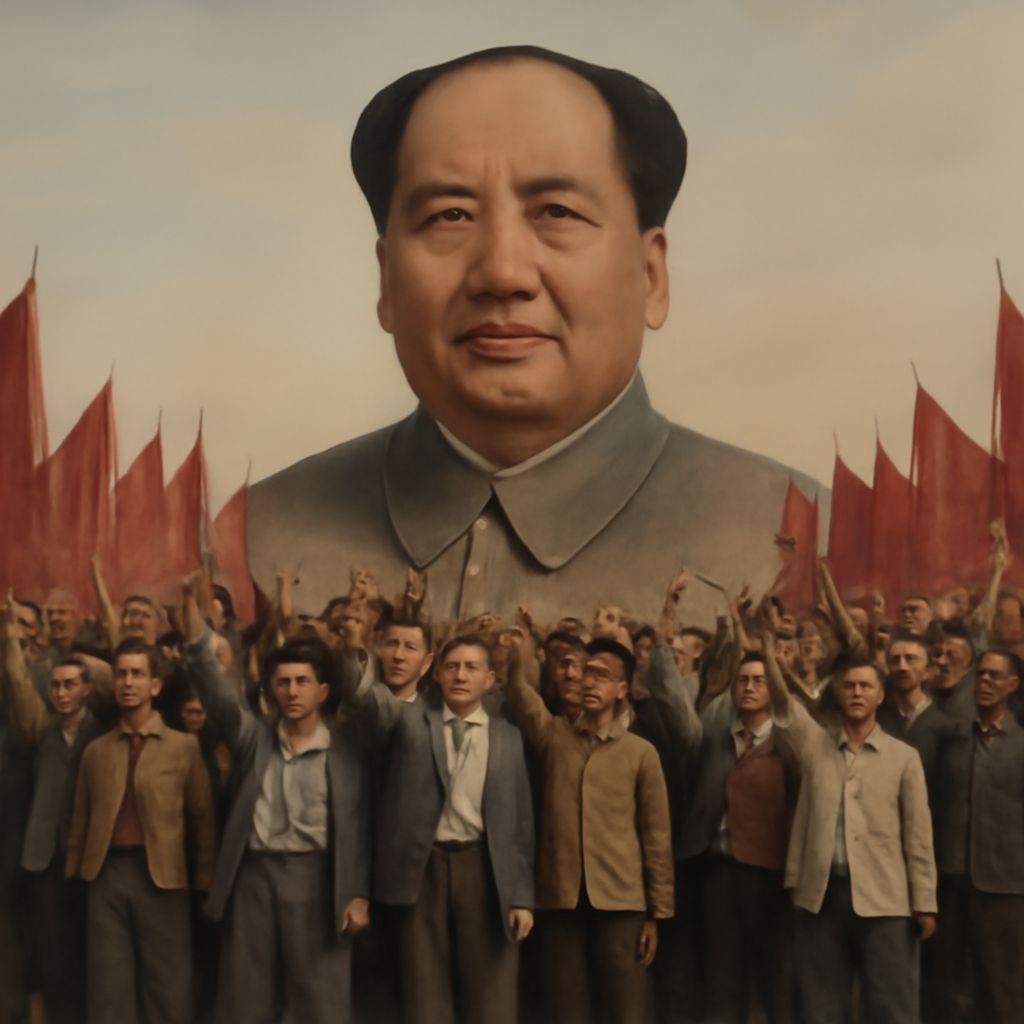
The Communist victory in China is sometimes treated as a single uprising in 1949. In fact, the revolution that brought Chinese Communists to power grew out of decades of political struggle, intermittent civil war, and resistance to Japanese invasion. On October 1, 1949, Mao Zedong proclaimed the People’s Republic of China (PRC), but the forces that made his announcement possible had developed over many years.
China’s Communist revolution involved two principal domestic rivals: the Chinese Communist Party (CCP) and the Nationalist Party, also known as the Kuomintang (KMT). They fought over who would govern China and how the country would be organized. The Cultural Revolution, launched by Mao in 1966, was a later political campaign within the PRC, with different immediate aims and a different setting.
China Communist Revolution: Rival Parties and a Broken Alliance
The fall of the Qing dynasty in 1911 had ended imperial rule, but the new Republic of China struggled to establish effective authority over the country. Regional military leaders, often called warlords, exercised power in many areas. Foreign influence and the weakness of central institutions also shaped the search for a new political order.
The CCP was founded in 1921. It initially cooperated with the Nationalists, whose leaders sought national unification. Communists joined the Nationalist-led Northern Expedition of 1926–27 against warlords. The alliance broke down in 1927 when Nationalist forces under Chiang Kai-shek attacked and purged Communists, turning a shared campaign into a struggle between rivals.
As the US State Department’s historical account explains, the subsequent civil conflict was interrupted and reshaped by the war against Japan. The Chinese Communist Revolution cannot be understood solely as a change of government in Beijing: its leaders built military and political organizations through years of conflict before taking national power.
Rural Bases and the War Against Japan
After the split, Communist forces retreated into rural areas, where they organized armed units and local administrations. Nationalist encirclement campaigns put those bases under severe pressure. During the Long March of 1934–35, surviving Communist forces undertook a prolonged retreat, eventually establishing a major base in the northwest. Mao emerged as the movement’s leading figure during this period.
In China, revolution developed in a largely rural society. Communist organizers sought peasant support through changes in land and rent policies, while building party networks and military forces. These policies and the party’s ability to enforce them differed over time and by place; support was neither uniform nor independent of the pressures of war.
Japan’s full-scale invasion in 1937 brought the Nationalists and Communists into a second, uneasy united front. Nationalist armies bore the main burden of conventional warfare against Japan. Communist forces expanded their presence in the countryside, using guerrilla warfare and local organization. Both parties also guarded their positions against each other, so the alliance against an external enemy did not settle the domestic contest.
Civil War and the 1949 Victory
Japan surrendered in 1945. Negotiations between Mao and Chiang, including mediation by US General George Marshall, failed to produce a durable coalition. Full-scale civil war resumed in 1946. The United States supported the Nationalist government with aid and transport, while the Soviet occupation of Manchuria after Japan’s defeat affected the struggle for that strategically important region.
The Nationalists initially held major cities and possessed substantial resources, but their position weakened. Inflation, corruption, and the demands of prolonged war damaged the government’s standing. Communist forces combined rural support and organization with military gains, and captured weapons and territory. These factors reinforced one another; no single explanation accounts for every regional outcome.
By 1948–49, major Communist victories had shifted the military balance decisively. Communist armies took Beijing and crossed the Yangtze River; Nanjing, the Nationalist capital, fell in April 1949. The Nationalist government eventually retreated to Taiwan, where the Republic of China continued to govern. Mao’s proclamation established a rival government on the mainland, although fighting continued in some areas after October.
The Chinese revolution changed who claimed authority over China, while leaving an unresolved division across the Taiwan Strait. In China, Communist revolution produced a new state; the Nationalist government’s survival on Taiwan meant that the civil war did not end in a single settlement accepted by both sides.
From Victory to a New Political Order
The new PRC placed the CCP at the center of political authority. A Communist-led government established institutions intended to govern the country, while the People’s Liberation Army supported the consolidation of control. Other parties participated in a consultative framework, but effective power rested with the Communist leadership rather than in an open contest for government.
Land reform became an early priority. Laws and campaigns redistributed land from landlords to peasants, transforming ownership and rural power. They also involved coercion, public denunciations, and killings. The benefits of receiving land and the violence used against those classified as landlords were both part of the change experienced in villages.
After the Communist revolution, China also faced the practical work of governing an economy damaged by years of war. The new authorities sought to restore order and production while extending political control. Their international position shifted too: the PRC drew close to the Soviet Union, while the United States continued to recognize the Republic of China on Taiwan for decades.
The Communist takeover in China therefore created institutions and social conflicts that preceded the Cultural Revolution. The latter began 17 years after the PRC’s founding and targeted perceived opponents and established authority within the existing Communist state; it was not another name for the civil war that brought that state into being.