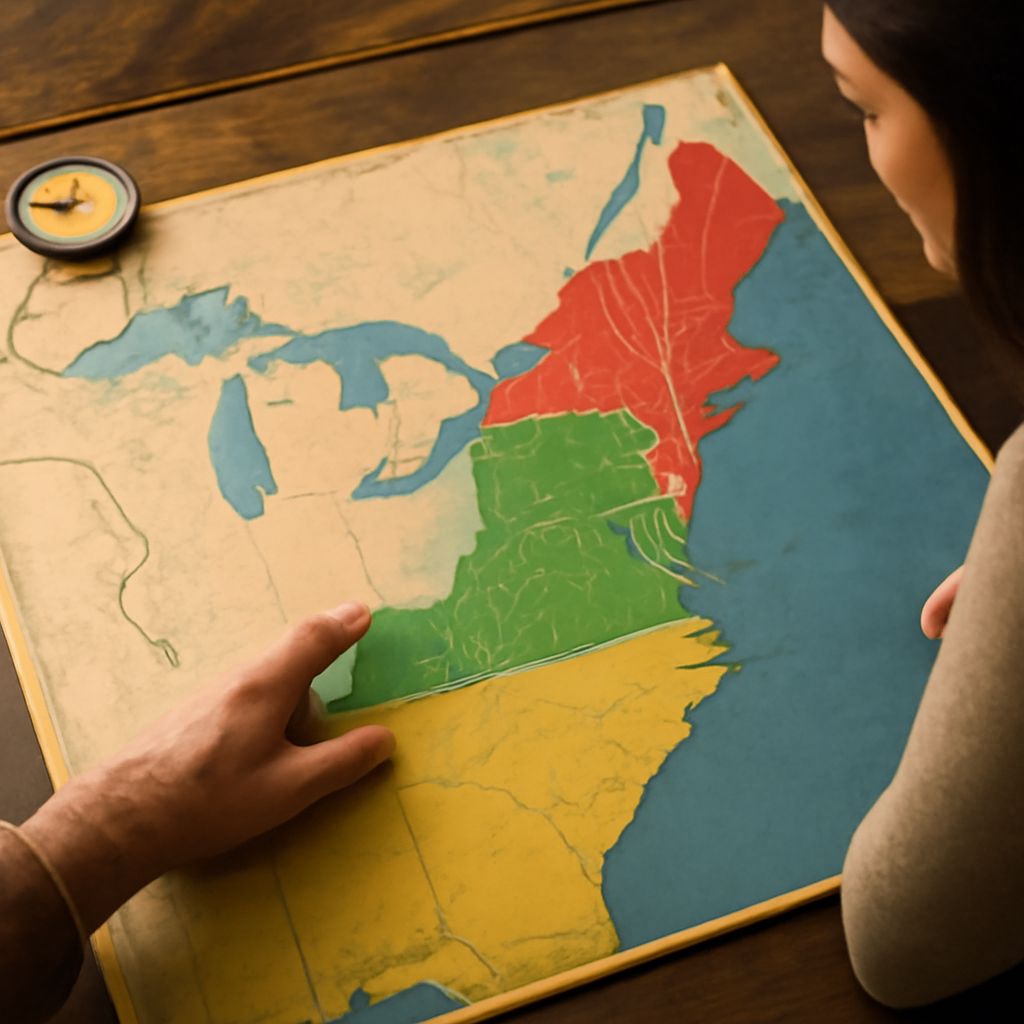
Virginia’s Jamestown settlement began in 1607; Georgia’s colonial charter followed in 1732. More than a century separated these beginnings, yet both became part of the original thirteen British colonies that declared independence in 1776. They occupied a long Atlantic coastal region and developed under different charters, economies, and local institutions.
The colonies in America were home to Indigenous nations long before English settlement. They also became part of an Atlantic system built on trade, dispossession, and enslaved labor. Understanding their transition to statehood requires distinguishing the founding of a settlement or colony from the later dates on which states ratified the US Constitution.
The American Colonies by Region
The original 13 colonies are commonly grouped into three regions. These labels help locate them, although boundaries and economic practices changed over time. From north to south, the colonies were:
New England
- New Hampshire: north of Massachusetts, along the Atlantic coast.
- Massachusetts: centered on Massachusetts Bay, with territory that included present-day Maine during the colonial period.
- Rhode Island: south of Massachusetts, around Narragansett Bay.
- Connecticut: on Long Island Sound, west of Rhode Island.
Middle Colonies
- New York: between New England and New Jersey, including the Hudson River valley.
- New Jersey: between the Hudson and Delaware rivers.
- Pennsylvania: west of New Jersey, extending inland from the Delaware River.
- Delaware: along the western shore of Delaware Bay, south of Pennsylvania.
Southern Colonies
- Maryland: around the northern Chesapeake Bay.
- Virginia: south of Maryland, extending inland from the Chesapeake region.
- North Carolina: south of Virginia, on the Atlantic coast.
- South Carolina: south of North Carolina, with a coast around Charleston.
- Georgia: south of South Carolina, bordering Spanish Florida.
These names identify the American colonies that joined the independence movement; Britain also held other North American and Caribbean colonies. The 13colonies shared an imperial connection, but their histories and governments were not identical.
Different Beginnings and Forms of Government
Jamestown began as a venture of the Virginia Company seeking profit, though the settlement endured severe disease, hunger, and conflict. In 1619 Virginia’s assembly met, giving some colonists a role in local lawmaking. Voting and officeholding were restricted, and the presence of an assembly did not give equal political rights to all inhabitants.
Massachusetts Bay was shaped in part by Puritan settlers seeking to build a religious community. Rhode Island developed a different reputation: its charter protected liberty of conscience to a greater extent than many neighboring governments. Pennsylvania, granted to William Penn in 1681, offered another model, with a proprietary founder and policies intended to attract settlers from several religious backgrounds.
Colonial institutions differed in their arrangements. A royal colony had a governor appointed under the crown; a proprietary colony operated under authority granted to an individual or group; charter colonies enjoyed varying degrees of self-government under their charters. These categories changed as charters were revised or revoked. Elected assemblies existed in many colonies, but political participation generally favored propertied men, and imperial authorities retained important powers.
The original British colonies were also places of forced labor and contested land. English expansion displaced Indigenous communities through war, coercive agreements, and settlement. Enslaved Africans and their descendants worked in every colony by the eve of the Revolution. As the National Park Service explains, slavery was especially important to plantation production in the South, while northern economies also depended on enslaved labor and Atlantic commerce.
From Imperial Subjects to Independence
After Britain’s victory in the Seven Years’ War in 1763, disputes over taxation, trade restrictions, and Parliament’s authority sharpened. Many colonists objected to taxes imposed by a Parliament in which they had no elected representatives. British officials argued that Parliament held authority throughout the empire. Protest, resistance, and British enforcement escalated into armed conflict in 1775.
Delegates meeting in the Continental Congress adopted the Declaration of Independence on July 4, 1776. The colonies declared themselves free and independent states, while the Revolutionary War continued. Individual states drafted or revised constitutions, and the Articles of Confederation later provided a framework for their collective government. Britain recognized US independence in the 1783 Treaty of Paris.
The language of independence did not confer equal freedom on everyone. Enslavement continued, women generally lacked the vote, and Indigenous nations faced continuing pressure on their lands. Different groups could therefore experience the creation of new governments in sharply different ways.
Founding Dates, Ratification, and Later States
The 13 states did not become colonies on one date, and their order of constitutional ratification does not measure their age. Delaware was the first to ratify the Constitution, on December 7, 1787. Rhode Island was the last of the original group to ratify, in 1790, as the National Archives records. The Constitution took effect among ratifying states after the required ninth approval, before the last two had joined under it.
The first 13 states are therefore the states formed from those colonies, not simply the thirteen oldest European settlements on the continent. Vermont, for example, entered the Union in 1791 as the fourteenth state; it was not one of the thirteen colonies that declared independence. Maine, formerly part of Massachusetts, became a separate state in 1820.
A compact timeline keeps the stages distinct: 1607–1732, colonial beginnings from Virginia’s Jamestown settlement to Georgia’s charter; 1776, independence declared; 1783, British recognition; 1787–1790, constitutional ratification by the thirteen original states; afterward, admission or formation of additional states.