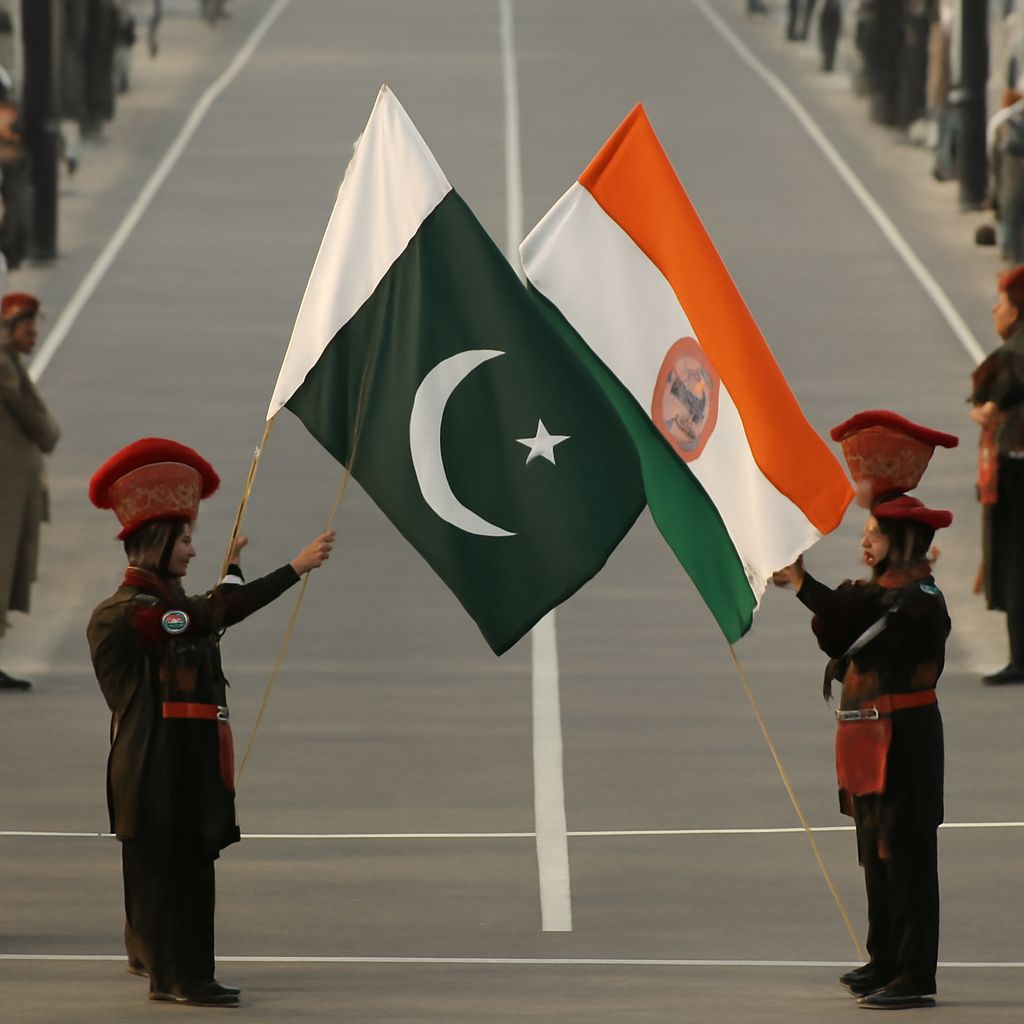
In 1947, the ruler of Jammu and Kashmir signed an accession to India as armed tribesmen advanced into his territory. That decision helped trigger the first war between India and Pakistan, establishing a territorial dispute that would recur in different forms. Yet the history of India versus Pakistan in war also includes a struggle over the future of what became Bangladesh.
The wars differed in their immediate causes, theaters and results. Examining each India Pakistan war in its own setting makes it easier to see both the persistence of the Kashmir dispute and the limits of explaining every crisis through it.
India vs Pakistan War: Partition and the First Kashmir Conflict, 1947–1948
British India was partitioned in August 1947 into India and Pakistan. Princely states could join either new country, and Jammu and Kashmir, a Muslim-majority state ruled by a Hindu maharaja, initially remained undecided. In October, tribal forces from Pakistan entered Kashmir. The maharaja sought Indian military assistance and signed an instrument of accession to India; India sent troops. Pakistan contested the accession, and its regular forces later joined the fighting.
The United Nations intervened diplomatically. A ceasefire took effect on January 1, 1949, leaving the former princely state divided between areas administered by India and Pakistan. UN proposals envisaged a vote on the territory’s future after demilitarization, but the conditions for that vote were never implemented. Both countries claimed the territory, and the ceasefire line became a lasting military boundary rather than an agreed international border.
1965: A Second Fight Over Kashmir
In 1965, clashes in the Rann of Kutch, a disputed marshland farther south, preceded a renewed confrontation in Kashmir. Pakistan sent infiltrators into Indian-administered Kashmir in August, hoping to encourage an uprising. India responded militarily, and fighting expanded across the international border into Punjab. The India vs Pakistan war became a contest involving substantial ground and air forces on several fronts.
Neither side achieved a decisive political victory. A UN-backed ceasefire took effect in September, and the Soviet-mediated Tashkent Declaration of January 1966 provided for withdrawal to positions held before the escalation. The U.S. State Department’s historical account describes the conflict as a stalemate that left Kashmir unresolved. The Pakistan India war showed how a plan centered on Kashmir could expand beyond the disputed region.
1971: East Pakistan Becomes Bangladesh
The next India and Pakistan war grew primarily out of Pakistan’s internal political crisis. Its eastern and western wings were separated by Indian territory. After an East Pakistani party won a parliamentary majority in 1970, the transfer of power stalled. In March 1971, the Pakistani military launched a crackdown in the east; mass violence followed, and millions of refugees fled into India.
India supported Bengali independence forces. Full-scale interstate fighting began on December 3, after Pakistan attacked Indian airfields in the west. Indian forces advanced in the east alongside Bengali fighters, and Pakistani forces there surrendered on December 16. Bangladesh emerged as an independent state. The State Department’s account traces the crisis from the blocked election to secession.
The 1972 Simla Agreement followed the war. It converted the Kashmir ceasefire line into the Line of Control, a military control line that divides areas administered by the two countries. The agreement did not settle sovereignty over Kashmir. Unlike the earlier wars, however, the decisive political outcome in 1971 was the creation of a new country. This war between Pakistan and India also reordered the balance of power in South Asia.
1999: The Kargil War in the Mountains
In 1999, Indian patrols discovered intruders occupying high positions on the Indian side of the Line of Control near Kargil. Pakistan described the fighters as Kashmiri militants; Pakistani soldiers were also involved. The positions threatened a highway linking Indian-administered Kashmir with Ladakh, making their location strategically significant.
India mounted a difficult campaign to retake the heights. Fighting remained largely confined to the Kargil sector, but took place after both countries had conducted nuclear tests in 1998. International pressure mounted, and Pakistani forces withdrew during July. India recovered the occupied positions. The limited India-Pakistan war ended without changing the Line of Control, while demonstrating that nuclear-armed rivals could still fight a conventional conflict.
2025: A Short, Dangerous Escalation
In April 2025, gunmen killed 26 people near Pahalgam in Indian-administered Kashmir. India blamed Pakistan for links to the attack; Pakistan denied involvement. On May 7, India struck sites in Pakistan and Pakistan-administered Kashmir that it said were linked to militants. Pakistan retaliated, and the sides exchanged further strikes before agreeing to stop military action on May 10. The United Nations welcomed the ceasefire.
The brief conflict differed from the territorial campaigns of 1947 and 1999: it followed an attack on civilians and involved strikes across a wider area. Each government claimed success, while accounts of losses and damage remained contested. The ceasefire ended the immediate exchange without resolving the underlying disputes. The fighting between India and Pakistan showed how quickly an attack on civilians could lead to direct strikes between the two states.
Why Does Kashmir Still Matter?
Kashmir remains divided, with India and Pakistan each administering part of the former princely state and claiming it in full. The Line of Control manages military separation, but it does not settle the competing claims or the political aspirations of people living in the region. Past agreements have ended particular episodes of fighting while leaving those questions for later negotiations.
How many wars were there? Four major wars are commonly counted: 1947–1948, 1965, 1971 and Kargil in 1999. The 2025 clash is also a serious armed conflict, though descriptions differ on whether it belongs in the same count.