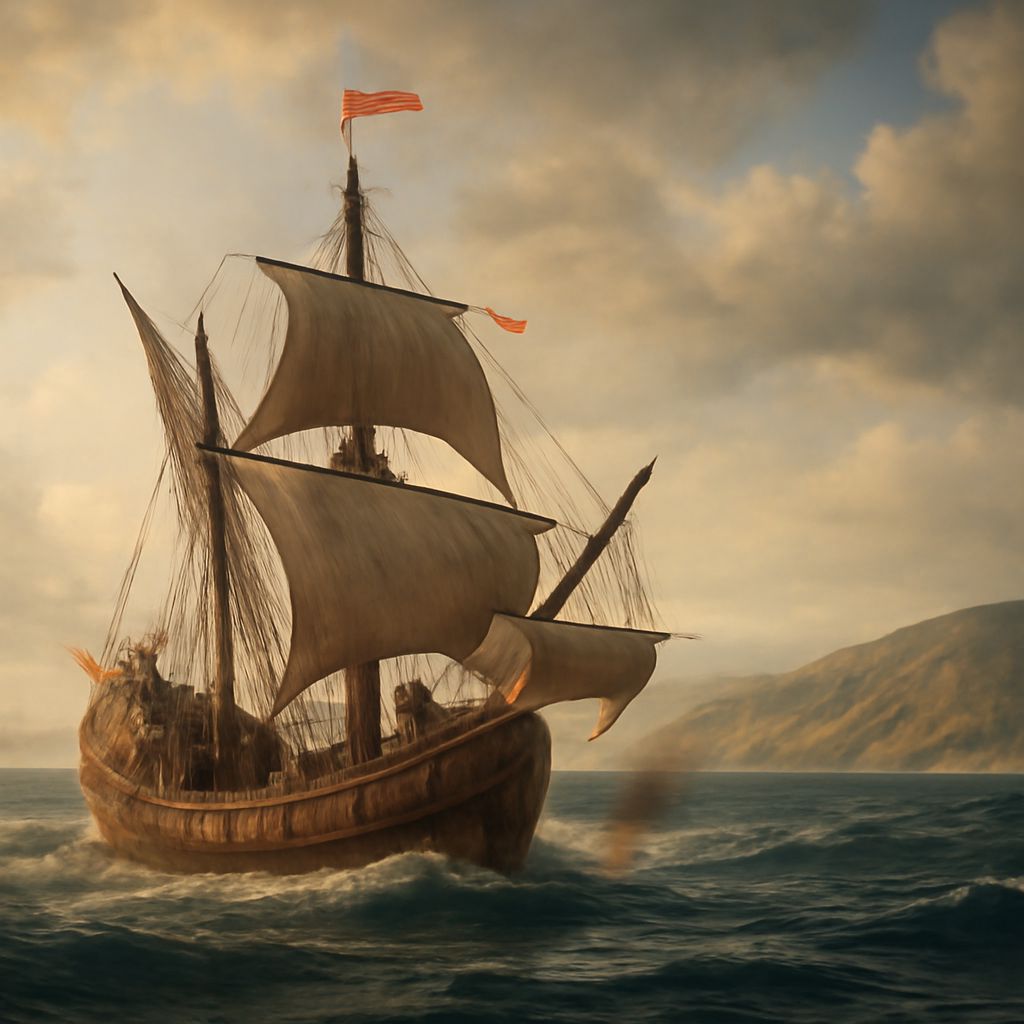
In September 1522, one ship from a five-ship Spanish expedition returned to Spain after sailing around the world. Its original commander, Ferdinand Magellan, was not aboard: he had been killed in the Philippines the previous year. The expedition’s achievement belongs to its surviving sailors and their final commander, Juan Sebastián Elcano, as well as to the leader who planned its westward route.
The question of what Magellan found requires attention to perspective. His fleet sailed a passage Europeans came to call the Strait of Magellan and crossed the Pacific, but people already inhabited many of the places it reached. Understanding who the Portuguese navigator was also means seeing the voyage as an imperial commercial enterprise, not simply a journey on a map.
Who Was Ferdinand Magellan: From Portugal to Spain
Born in Portugal around 1480, Magellan served in Portuguese expeditions in the Indian Ocean and Southeast Asia. Those voyages gave him experience of maritime warfare and trade in a region where Portugal sought control of sea routes and valuable spices. He later sought support from the Spanish crown for a different approach to the Spice Islands, also known as the Moluccas, in present-day Indonesia.
Who was Ferdinand Magellan in relation to Spain? He was a Portuguese navigator who entered Spanish service and secured royal backing from Charles I. Spain and Portugal competed for trade and overseas claims, with the Treaty of Tordesillas used to divide their claimed spheres. Magellan proposed reaching the islands by sailing west, seeking a passage around the southern end of South America.
The proposed route promised a Spanish connection to the spice trade without relying on Portugal’s eastward route around Africa. Its geography was poorly understood by the expedition’s European sponsors. The fleet left Spain in 1519 with five ships, provisions, and crews drawn from several parts of Europe; the voyage would test both the route and the authority of its commander.
The Strait and the Pacific Crossing
The ships crossed the Atlantic and followed the South American coast southward. The expedition faced shortages, severe weather, conflict among its officers, and a mutiny during a winter stop in Patagonia. Magellan suppressed the revolt; one ship was wrecked, and another later turned back toward Spain.
In 1520, the remaining ships entered a difficult channel at the continent’s southern tip. Navigating its winding waterways, they emerged into the ocean Magellan named the Pacific. This was a consequential European navigation of a route between the Atlantic and Pacific; the surrounding lands and waters were not an empty or unknown world to the Indigenous peoples who lived there.
What did Ferdinand Magellan discover for European navigation? His expedition demonstrated a navigable western passage into the Pacific, though its hazards made it a demanding route. The crossing that followed also exposed the enormous scale of that ocean. Crews endured hunger and disease during months at sea, with limited opportunities to replenish supplies.
Encounters and Death in the Philippines
The fleet reached islands in the western Pacific in 1521 and continued to the Philippine archipelago. On Cebu, Magellan formed an alliance with a local ruler and participated in religious and political negotiations. Such encounters involved communities with their own leaders, trading networks, and interests; they were not merely stages in a European voyage.
Magellan then intervened in a conflict involving Mactan. On April 27, 1521, forces associated with the local leader Lapulapu resisted Magellan’s landing, and Magellan was killed. The Library of Congress describes the event in the context of competing interpretations of the expedition and its place in Philippine history.
Who is Ferdinand Magellan in this history? He was both a navigator who led a difficult maritime expedition and an agent of a crown seeking influence and commercial advantage. Those roles help explain why the expedition’s consequences included violence and later imperial claims alongside new European geographical knowledge.
Elcano’s Return and the Voyage’s Legacy
After Magellan’s death and further losses, the remaining expedition continued to the Moluccas. The ship Victoria, under Juan Sebastián Elcano, sailed west across the Indian Ocean and around the Cape of Good Hope. It reached Spain in 1522. Eighteen survivors returned aboard the vessel; other expedition members were detained or returned by different routes later.
Magellan history is often told as the story of one explorer, but the surviving crew’s navigation and decisions completed the circuit. Antonio Pigafetta, one of the survivors, recorded the journey; his narrative is an important source, read with attention to his position as a participant in the expedition.
For Ferdinand Magellan, significance comes from leading the expedition through the Atlantic passage and into the Pacific, as well as from the wider consequences of the voyage he began. The circumnavigation connected routes previously known from different directions and informed European maps and imperial ambitions. It also formed part of a history of competition, coercion, and encounters with societies that had their own histories long before Europeans arrived.
Who completed the voyage after Magellan died? Elcano commanded Victoria home with the surviving sailors in 1522. The distinction matters because Magellan did not personally circumnavigate the globe, and the expedition’s completion depended on people who navigated and endured the voyage after his death.