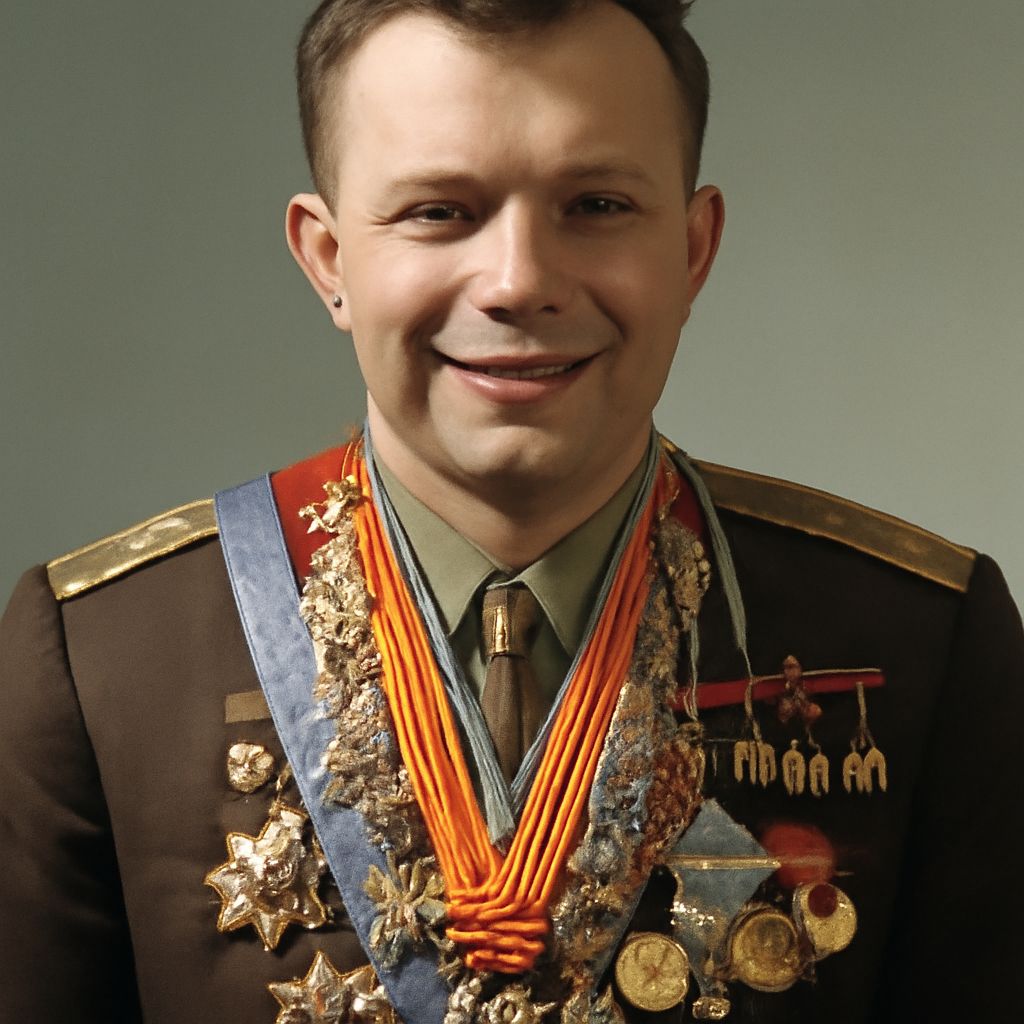
The story of human spaceflight begins with a single, courageous individual: Yuri Gagarin. On April 12, 1961, Gagarin became the first man in space, making history with his pioneering journey aboard Vostok 1. This moment not only marked a turning point in the space race but also inspired generations worldwide to look to the stars. Gagarin’s achievement was more than a technical milestone—it was a triumph of vision, courage, and international competition.
Who Was the First Man in Space?
The first man in space was Yuri Gagarin, a Soviet Air Force pilot born on March 9, 1934, near the small town of Gzhatsk, Russia. Gagarin’s selection as the first human to journey beyond Earth’s atmosphere was the result of both his exceptional skills as a pilot and his strong character. He stood out during the rigorous Soviet cosmonaut selection process, which demanded not just physical fitness but also psychological resilience and quick decision-making abilities.
Gagarin’s background was humble. Growing up in a farming family during difficult wartime years, he developed a strong work ethic and a passion for aviation. He attended technical school and then joined the Soviet Air Force, where his natural aptitude for flying became apparent. Out of thousands of candidates, Gagarin emerged as the ideal choice to represent humanity in space for the first time.
His selection was kept secret until the successful completion of his mission. After his historic flight, Yuri Gagarin quickly became a global celebrity and a symbol of Soviet achievement during the Cold War era. As the first person to orbit Earth, he opened a new chapter not just in science and technology, but in the potential of human exploration.
Yuri Gagarin’s Vostok 1 Mission
Preparation and Launch
The Vostok 1 mission was meticulously planned and executed by the Soviet space program. Preparations took years and required solving countless technical challenges. Gagarin and his backup, Gherman Titov, underwent intense training that included zero-gravity simulations, isolation chambers, and emergency recovery exercises. These tests ensured that the chosen cosmonaut could cope with the physical and psychological stresses of spaceflight.
On the morning of April 12, 1961, Gagarin suited up in an orange pressure suit and boarded the Vostok 1 spacecraft at the Baikonur Cosmodrome. The launch vehicle, a modified R-7 rocket, stood 38 meters tall. As the final countdown reached zero, Gagarin’s famous words—“Poyekhali!” (“Let’s go!”)—echoed through mission control, capturing the excitement and uncertainty of the moment.
The launch went smoothly, propelling Vostok 1 into orbit in less than ten minutes. Gagarin reported feeling healthy and alert as he experienced weightlessness for the first time. Soviet engineers remotely controlled the spacecraft during flight, with manual override reserved for emergencies. Gagarin’s main task was to observe, report, and endure—the true test of human adaptability to space.
Achievements and Milestones
Vostok 1 completed a single orbit of the Earth, covering a distance of about 40,000 kilometers in 108 minutes. Gagarin reached a maximum altitude of 327 kilometers above the planet’s surface and traveled at speeds up to 27,400 kilometers per hour. These achievements established several historic milestones: first human in space, first to orbit Earth, and first to experience the challenges of re-entry and landing.
The return to Earth was not without drama. At the end of the orbit, Vostok 1’s re-entry module separated from the service module with some difficulty, causing the capsule to spin for a brief period. Gagarin endured the intense G-forces of re-entry before ejecting from the capsule at 7,000 meters, descending safely by parachute to a field near the village of Smelovka. Local farmers and children were the first to greet him, stunned by the arrival of a man in a bright suit from the sky.
Gagarin’s successful mission proved that humans could survive and function in space, validating the spacecraft design, life support systems, and training protocols developed by Soviet engineers and scientists. The accomplishment made the Soviet Union the unquestioned leader in the early space race.
Impact on Space Exploration
Yuri Gagarin’s flight fundamentally changed the course of space exploration. It demonstrated that human spaceflight was possible and practical, opening the door for more complex missions. The space race intensified, pushing both the Soviet Union and the United States to invest heavily in science, engineering, and astronaut training programs.
Vostok 1’s success inspired rapid advancements in rocket technology, life sciences, and mission planning. Within a few years, both nations delivered significant milestones: the first woman in space, multi-person crews, spacewalks, and eventually the U.S. Apollo lunar landings. Gagarin’s achievement also spurred international cooperation in space, leading to shared scientific missions and, decades later, the establishment of programs like the International Space Station (ISS).
The cultural impact was just as profound. Around the world, Gagarin’s journey was celebrated as a triumph of human ingenuity and courage, inspiring a new generation to dream of exploring the cosmos. His mission helped shape public attitudes toward space exploration, encouraging support for research and education in science and technology.
Legacy of Yuri Gagarin
Yuri Gagarin’s legacy endures more than sixty years after his historic flight. He is remembered as not only the first man in space but also as a symbol of hope, unity, and pioneering spirit. Statues and memorials in Russia and around the globe honor his contribution to humanity’s quest for knowledge.
Gagarin’s name is associated with countless institutions, from schools and streets to research centers and spacecraft. The annual celebration of Cosmonautics Day on April 12 marks his achievement, and his story is a cornerstone of both Russian national pride and world space history.
He continued to work as a test pilot and trainer after his flight, serving as a mentor to the next generation of cosmonauts. Gagarin’s life was cut tragically short in 1968, but his inspiration lives on. Every launch, every leap into the unknown, carries a piece of Gagarin’s legacy—a reminder that humanity’s first step into space began with his courage and his smile.