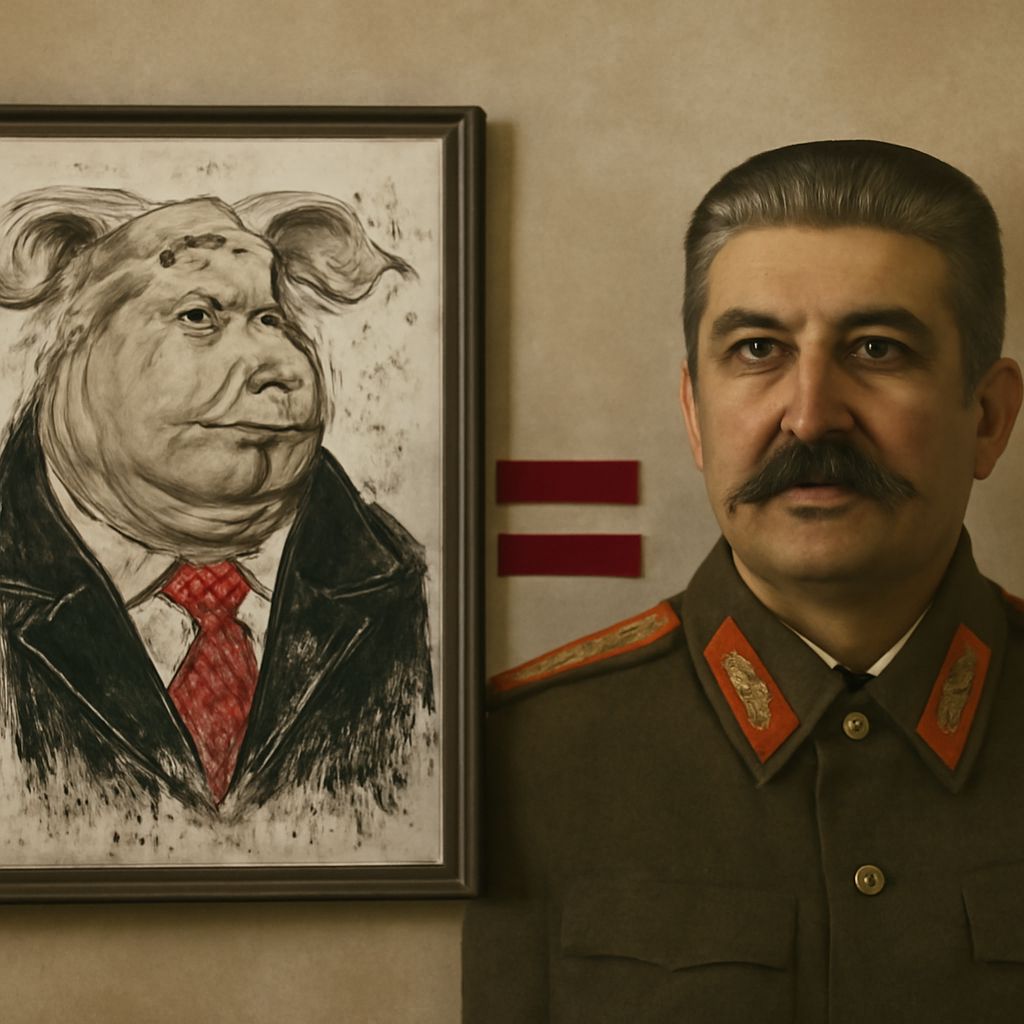
George Orwell uses propaganda in Animal Farm to show how leaders can turn language into a tool of control. The pigs gain authority through slogans, selective facts, fear, rewritten history, and repeated claims that their decisions benefit everyone.
The novel mirrors important features of Soviet propaganda, but its characters are not exact one-to-one portraits of historical figures. Orwell compresses several political events and methods into a simple fable so readers can see how public opinion is shaped.
Propaganda in Animal Farm: Orwell’s Soviet Parallel
After the rebellion, the animals believe they are creating an equal society. The pigs gradually take control of food, education, law, and communication. Because most animals cannot read well or remember events clearly, the pigs can present their version of the past as truth.
Squealer is the clearest example of an official propagandist. He uses confident speeches, impressive statistics, and frightening alternatives to defend the pigs. When the animals question the pigs’ privileges, Squealer asks whether they want Jones to return. This turns reasonable criticism into an apparent threat to the entire revolution.
The pigs also reduce complex political ideas to memorable slogans. “Four legs good, two legs bad” first unites the animals, but the pigs later alter it to support their own behavior. The changing commandments show how propaganda can make injustice appear lawful when authorities control the record.
Propaganda in the Soviet Union: Historical Context
Soviet Union propaganda developed through newspapers, posters, speeches, radio, education, public ceremonies, and carefully managed images of political leaders. After the 1917 Russian Revolution, the Bolshevik government used communication to defend the revolution, mobilize workers, and identify enemies during civil war and political conflict.
Under Joseph Stalin, propaganda became closely tied to state power. Newspapers praised industrial targets and agricultural policies, even when ordinary people experienced shortages, forced collectivization, or severe hardship. Political opponents were described as traitors or enemies, while official histories increasingly presented Stalin as the central guardian of the revolution.
These methods parallel events in Animal Farm. The pigs claim that production is improving, blame failures on Snowball, and portray Napoleon as essential to safety. Like Soviet officials who controlled public narratives, they make loyalty seem patriotic and disagreement seem dangerous.
Still, Orwell does not assign every animal or event to one historical person or episode. Napoleon draws on features associated with Stalin, while Snowball recalls aspects of Leon Trotsky, but the novel’s purpose is broader: it shows how revolutionary promises can be weakened by concentrated power.
How Propaganda Operates in the Novel
Control of information: The pigs become the main interpreters of events. Squealer tells the animals what happened, while the animals’ limited literacy prevents them from checking the commandments for themselves. Information becomes a privilege rather than a shared public resource.
Repetition: The sheep constantly repeat “Four legs good, two legs bad.” Their chant interrupts debate and replaces thought with noise. Repetition works because familiar claims can feel true even when they are unsupported.
Fear and scapegoating: Napoleon uses trained dogs as physical enforcement, but fear also works through stories about Jones, Snowball, and supposed attacks from outside. When anything goes wrong, Snowball is blamed. This gives the animals a simple enemy and protects the ruling group from responsibility.
Statistics and euphemism: Squealer announces figures that suggest life is improving, although the animals have less food and greater workloads. He also uses mild or technical language to soften harsh realities. Word choice makes exploitation sound like administration.
Historical revision: The commandments are changed gradually, and the animals’ memories are challenged whenever they conflict with the pigs’ story. The execution scene also shows how public confessions can be staged to prove that the leadership’s enemies deserve punishment.
Symbols and ceremonies: Songs, flags, medals, speeches, and public celebrations create emotional loyalty. These rituals connect the government to the original rebellion, allowing Napoleon to claim the revolution’s moral authority even as he abandons its principles.
Is Diction a Rhetorical Device?
Yes, diction is a rhetorical device, or at least a deliberate rhetorical choice. The question “is diction a rhetorical device” has a direct answer: diction means the words a speaker or writer selects, and those choices influence tone, emotion, credibility, and interpretation.
In Animal Farm, diction changes how the animals understand power. Calling the pigs’ privileges “adjustments” makes inequality sound minor and practical. Calling opponents “traitors” or “criminals” makes them seem dangerous before anyone examines the evidence. Calling labor “voluntary” hides the pressure created by hunger, threats, and authority.
The phrase “more equal” is especially powerful. Grammatically, equality cannot have degrees, so the phrase exposes the absurdity of the pigs’ new system. Its plain words imitate a legal rule while quietly destroying the rule’s meaning.
Squealer’s diction also differs from Boxer’s. Boxer relies on short, loyal statements such as “Napoleon is always right,” while Squealer uses long explanations and official-sounding vocabulary. Both forms support obedience, but they reach the audience differently: Boxer models emotional loyalty, while Squealer manufactures intellectual justification.
Plain-Folks and Transfer Techniques
Plain folks is a technique in which a leader or organization presents itself as ordinary, familiar, and connected to everyday people. The goal is to reduce distance between authority and its audience. The phrase plain folks advertising usually describes advertisements that show a product being used by ordinary families, workers, or neighbors rather than by experts or celebrities.
In the novel, the pigs use a version of this appeal when they speak as fellow animals who share the farm’s hardships and claim to work for the common good. Their language of “comrades” suggests equality, even as their behavior becomes increasingly separate from the other animals. Boxer, by contrast, genuinely represents the hardworking ordinary animal; his trust makes the pigs’ message seem connected to the farm’s working population.
Transfer propaganda definition: transfer is a technique that moves the respect, fear, or emotional force attached to one person, symbol, or cause onto another person or policy. It does not merely claim that a leader is ordinary. It borrows authority from something the audience already values.
Napoleon uses transfer when he associates his rule with the rebellion’s ideals, the animals’ flag, and memories of Old Major. Ceremonies and songs help transfer the revolution’s original hope onto the new government. The pigs also transfer fear from Jones and Snowball onto anyone who questions Napoleon.
Soviet examples included the use of revolutionary symbols, heroic images of leaders, patriotic ceremonies, and official links between party decisions and the achievements of the revolution. Plain-folks appeals seek identification—“the leader is one of us”—while transfer seeks association—“this leader or policy carries the authority of a respected symbol.”