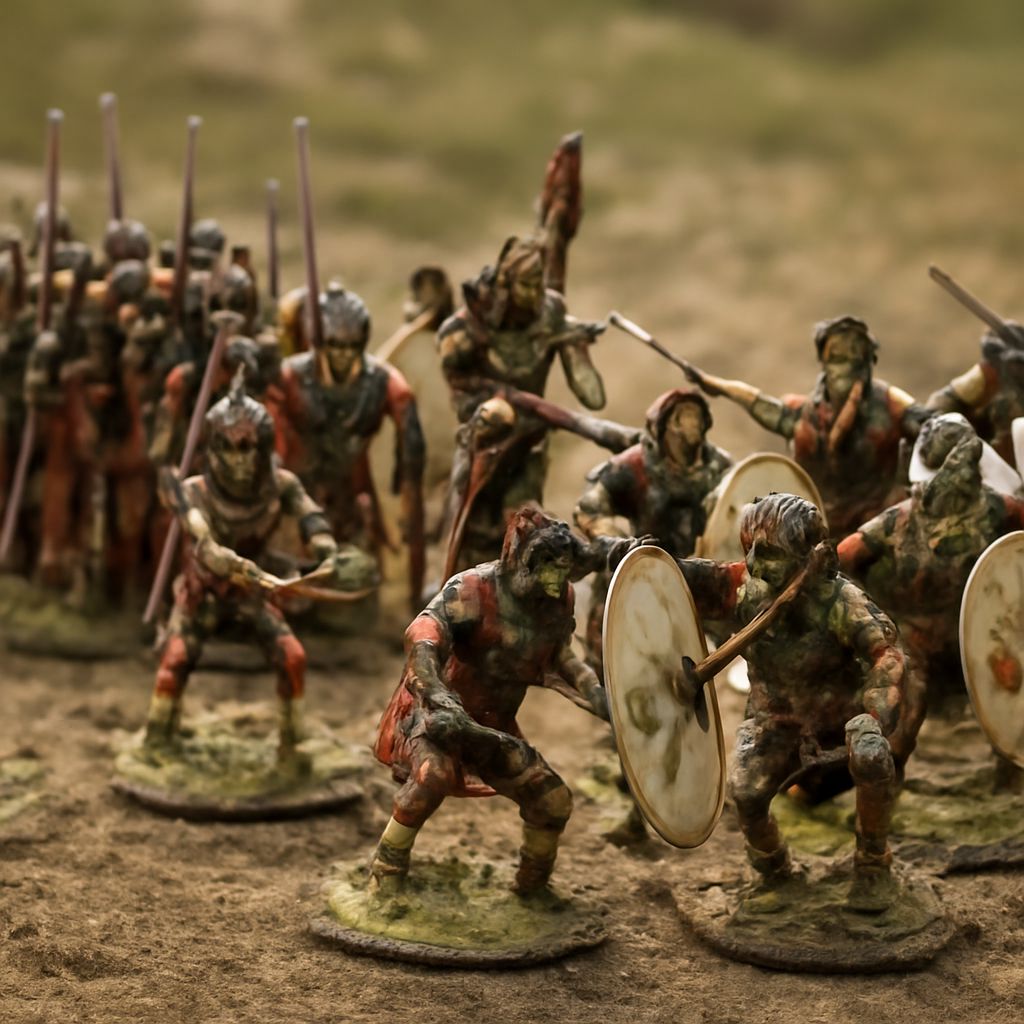
Roman legion organization was a layered system built to keep thousands of soldiers under control in camp and battle. In the imperial period, a legion normally contained ten cohorts, while centurions, tribunes, and a legate connected the smallest groups to high command. Its equipment supported the same aim: disciplined movement under pressure.
The Roman army later faced different borders, enemies, and fiscal limits. The Byzantine army kept Roman ideas such as professional command, written orders, and combined arms, but reorganized recruitment, field forces, and frontiers. The result was continuity in military culture, not an unchanged legion.
How Roman legion organization worked: command, cohorts, and centuries
For a representative imperial legion of the first and second centuries CE, the legatus legionis was the senior commander. A senior tribune from the senatorial class, several junior tribunes, and the praefectus castrorum, or camp prefect, handled command, administration, training, and supply.
The legion’s main body had ten cohorts. The first cohort usually held five double-strength centuries, giving it about 800 men, while each of the other nine cohorts normally had six centuries of roughly 80 soldiers. Actual strengths changed with losses, detachments, and period.
A century was led by a centurion, supported by an optio as deputy and a signifer who carried its standard. The oldest and most senior centurion, the primus pilus, commanded the first cohort’s senior century and sat at the top of the centurionate.
Below the century, soldiers lived and worked in contubernia, small groups of about eight men sharing a tent and equipment. This structure made a legion more than a mass of infantry: officers could issue orders through a dependable chain from the legate to the cohort, century, and squad.
The Roman legionary shield: construction, use, and historical variation
The Roman legionary shield was usually the scutum, a large curved shield designed for close-order infantry. It was commonly built from thin layers of wood glued together, then covered with canvas or leather, with a reinforced rim and a central iron or wooden boss protecting the handgrip.
Most early imperial scuta were tall and curved, often reaching from the shoulder toward the shin. Their convex shape helped deflect blows, while the boss could be driven into an opponent at close range. The shield protected the left side of the body while the soldier used a sword in the right hand.
In formation, shields could overlap to reduce gaps and create a strong front. Soldiers could also raise them overhead in the testudo against missiles, although this formation reduced speed and visibility. The scutum therefore served as mobile cover, a formation tool, and a limited offensive weapon.
Its shape was not fixed across Roman history. Republican armies used large oval shields, and the familiar curved rectangular form became especially associated with early imperial legions. By the third and fourth centuries, oval and round shields became more common, while auxiliary units often carried different designs from the start.
From the Roman army to the Byzantine army: mobile field forces and change
The late Roman army did not simply preserve the early imperial legion. From the third century onward, emperors used smaller units, regional commands, fortified bases, and more mobile forces to respond to threats on several frontiers at once.
Two broad categories became important in the fourth century. Comitatenses served in mobile field armies that could move toward a crisis, while limitanei performed frontier duties near forts and settlements. These labels describe changing roles rather than a perfect division: units could be transferred, upgraded, or reorganized.
Old legionary names sometimes survived even when units were much smaller than their imperial predecessors. Field armies also relied more heavily on cavalry, archers, and troops recruited through treaties with non-Roman groups. This was an adaptation to steppe warfare, Persian armies, civil conflict, and the need for rapid movement.
In the eastern Roman state, commanders increasingly directed mixed forces rather than a classic legionary line. The army remained Roman in its law, hierarchy, and state purpose, but its battlefield system placed greater weight on cavalry, missile troops, fortified defense, and coordinated maneuver.
Byzantine army structures: recruitment, cavalry, frontier forces, and administration
From the seventh century, the theme system became a major framework for the Byzantine army. A theme was both a provincial district and a military command, led by a strategos who combined important civil and military authority. It was not a direct replacement for a Roman cohort or legion.
Thematic soldiers, often called stratiotai, were connected to local landholding and tax obligations, though the details varied by period and region. This system gave the state a way to maintain provincial forces and support defense without relying entirely on a centrally paid standing army.
The capital also maintained professional central units known as the tagmata. Regiments such as the Scholai, Excubitors, Vigla, and Hikanatoi guarded Constantinople, protected the emperor, and formed a reliable core for field campaigns. They could reinforce thematic armies without replacing them.
Frontier organization changed as pressure increased. Fortified districts called kleisouriai guarded difficult border corridors, while local commanders and soldiers defended strongholds and passes. The older idea of permanent frontier troops continued in altered form, but frontier forces were now part of a more flexible network of forts, provinces, and mobile reinforcements.
Byzantine cavalry became central to this system. The army used armored lancers, mounted archers, and mixed formations that could scout, harass, charge, or withdraw. Infantry remained important for holding terrain and forts, but the army’s manuals and commanders stressed cooperation between cavalry, missile troops, and defensive formations.
Administration also moved away from the simpler legionary model. Generals, provincial officials, tax administrators, and court ministries managed recruitment, pay, supply, and deployment across separate commands. In later centuries, weakened themes, pronoia land grants, mercenaries, and foreign allies supported smaller and more fragmented forces than those of the early Roman Empire.