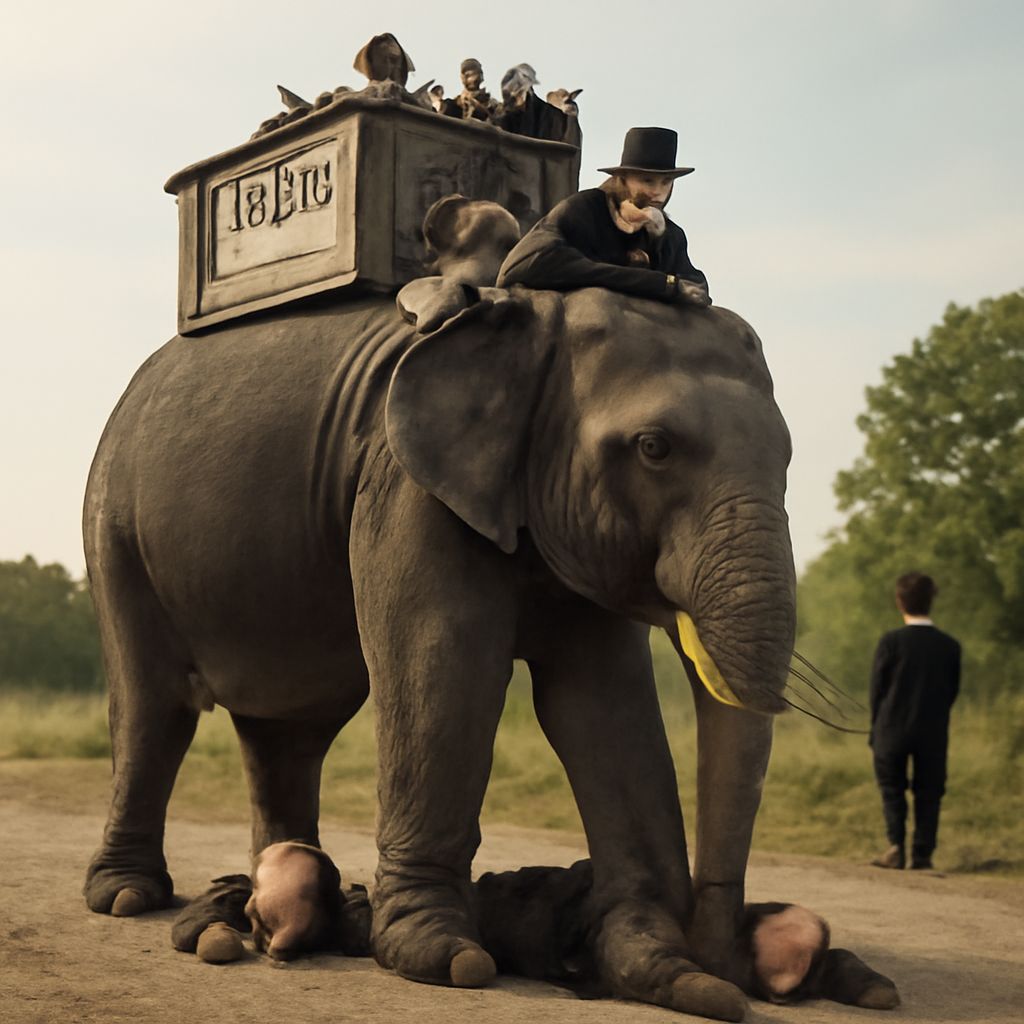
The political donkey and Republican elephant are familiar labels for the Democratic and Republican parties. They are political symbols shaped by campaigns, newspapers, and cartoons, not emblems established by the U.S. Constitution. They help voters recognize party coalitions, but they do not define the country’s form of government.
Their histories began with separate associations. The donkey grew from an insult aimed at Andrew Jackson, while the elephant became linked to Republicans through nineteenth-century political art. Thomas Nast made both images far more memorable and helped establish them as lasting political shorthand.
How the political donkey emerged
In 1828, opponents of Andrew Jackson called him a “jackass,” connecting the animal with his stubborn personality and rough political style. Jackson’s campaign did not simply reject the insult. It used donkey imagery to suggest strength, independence, and persistence, helping attach the animal to his Democratic movement.
After Jackson, the donkey appeared occasionally in Democratic cartoons and commentary, but it was not yet a fixed party mark. In 1870, Nast’s A Live Jackass Kicking a Dead Lion used a donkey to represent Democrats attacking the memory of Edwin M. Stanton, a Republican secretary of war.
That cartoon gave the animal a large national audience. Other cartoonists repeated the image, and the donkey gradually became a recognizable stand-in for the Democratic Party. The symbol’s meaning could change from cartoon to cartoon, but its party association endured.
Thomas Nast and the donkey and elephant symbols
Thomas Nast was a German-American illustrator whose work in Harper’s Weekly influenced public opinion during the nineteenth century. He did not invent every use of either animal, but his widely circulated cartoons connected the donkey and elephant with the two major parties more firmly than earlier images had.
His most important elephant cartoon appeared in 1874. In The Third-Term Panic, an elephant labeled “The Republican Vote” appears frightened by the possibility that President Ulysses S. Grant might seek a third term. The cartoon helped make the elephant a durable symbol of the Republican Party.
The elephant had appeared in political imagery before Nast’s famous cartoon, and the donkey already had Democratic associations. Nast’s specific contribution was popularization: he used clear labels, memorable animals, and mass-circulation newspapers to give scattered political references a common visual language.
What the U.S. republic means
A republic is a system in which public authority is exercised through representatives and a constitution rather than through hereditary rule by a monarch. In the United States, voters choose officials who make, enforce, and interpret laws within constitutional limits.
The United States is also described as a democratic republic. “Democratic” points to popular participation and elections, while “republic” points to representative government, constitutional rules, and limits on official power. These features work together rather than describing competing systems.
The Constitution divides federal authority among the legislative, executive, and judicial branches. It also creates federalism, checks and balances, protections for individual rights, and regular elections. Those structures continue whether Democrats, Republicans, or another coalition holds office.
Party symbols versus constitutional institutions
Political parties are organized coalitions, not branches of government. They recruit candidates, write platforms, raise money, organize voters, campaign for offices, and coordinate elected officials who share broad goals.
A party can win the presidency, control one or both chambers of Congress, or hold a majority of state offices. It does not own those institutions, however. A Democratic president remains part of the executive branch, a Republican senator remains part of the legislative branch, and neither party becomes a constitutional branch itself.
Party labels and animal symbols help voters identify candidates on ballots and in public debate. They are useful branding, but they do not guarantee identical policies or permanent positions. The donkey and elephant describe political organizations within the U.S. republic; they are not symbols of the republic’s constitutional structure.