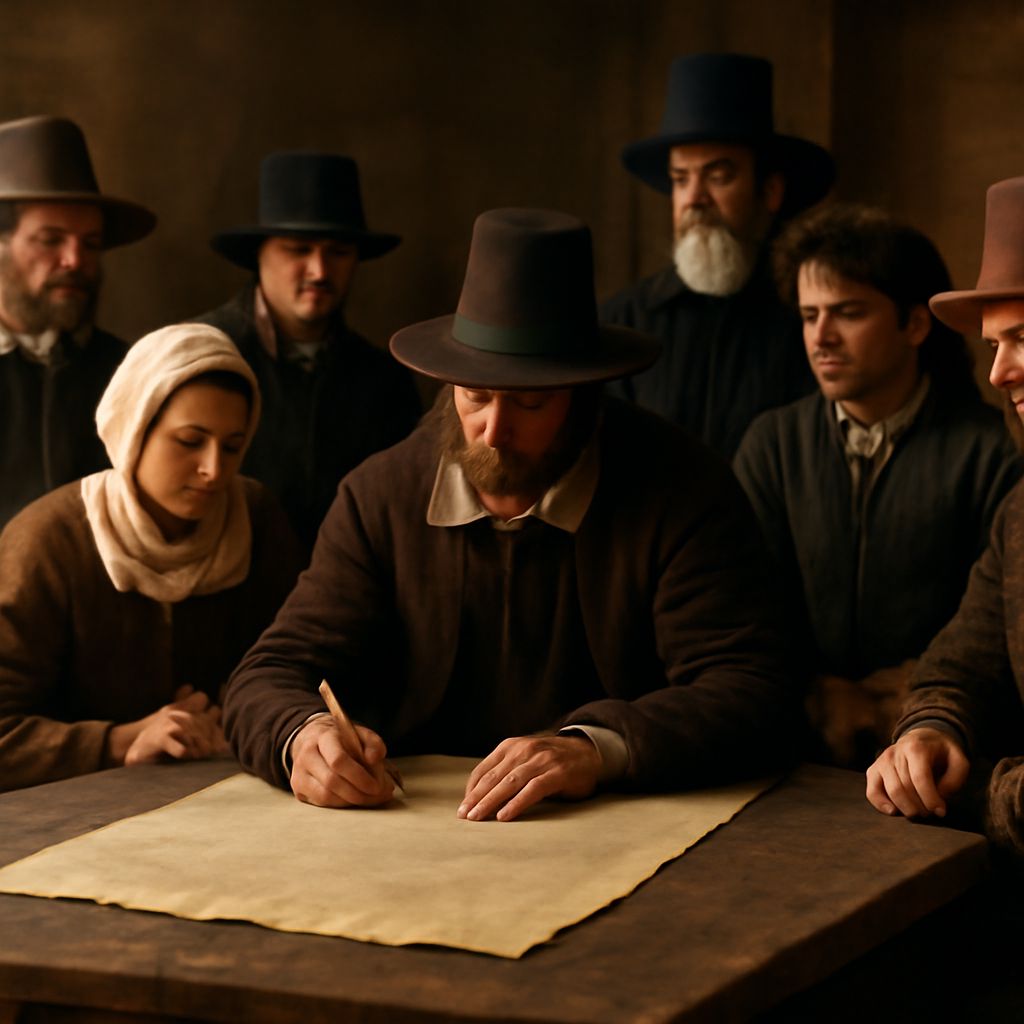
The Mayflower settlers’ agreement was not a declaration of independence from England. Signed aboard ship in 1620, it affirmed loyalty to King James while joining the signers in a body that could make rules for their settlement. Its immediate purpose was practical: the passengers had arrived outside the area covered by their intended patent and needed a basis for governing themselves.
The Mayflower agreement later became an important example in American discussions of political consent. Its original scope was narrower: it organized a particular group of English colonists, not everyone who lived on or near the land they intended to settle.
The Mayflower Compact: What Did It Create?
What is the Mayflower Compact? It was a brief written agreement made by passengers on the Mayflower at Cape Cod on November 11, 1620, under the calendar then used in England. It joined the signers into a “civil body politic”: a political community authorized, in their account, to establish laws and offices for the colony’s general good. The signers promised to submit to the rules made under that arrangement.
The State Library of Massachusetts provides both an image of William Bradford’s handwritten copy and transcriptions in original and modernized spelling. Its text names God, the Christian faith, King James, and the intended colony. It does not lay out a detailed constitution with separate branches of government, a bill of rights, or a procedure for every future decision.
The agreement called Mayflower Compact, 1620 being its year of signing, gave the small settlement a written basis for collective rule. The agreement’s importance lies in that commitment and in the circumstances that made it useful, rather than in powers later readers may wish it had specified.
Why Make an Agreement at Cape Cod?
The passengers had planned to settle within territory associated with the Virginia Company. Their ship reached Cape Cod, and an attempt to travel south encountered dangerous conditions. They returned to the harbor and decided to settle outside the area of their intended patent, an authorization connected with the proposed settlement.
That location raised a governing problem. The people aboard included religious Separatists seeking a community outside the Church of England, as well as other passengers with different reasons for joining the voyage. Bradford later reported “mutinous speeches” among some passengers who argued, in effect, that they would not be bound by the existing arrangements after landing outside the patent’s territory. His account was written later and presents the dispute from a colonial leader’s perspective.
The agreement offered a common commitment before the group established Plymouth. It did not secure Indigenous permission to occupy the land, and it did not turn an English patent into ownership of territory by itself. It did, however, provide the colonists with an agreed basis for creating offices and rules among themselves. John Carver was chosen governor, giving the group an officer to lead its early affairs.
What Did the Signers Promise?
The text joins religious purpose, allegiance to the Crown, and an undertaking to organize civil government. It says the signers will combine into a political body for their ordering and preservation, then make laws and appoint offices suited to the colony’s general good. Their promise of obedience was part of the bargain: rules would have little practical force if each passenger remained free to disregard them.
This is the clearest answer to what the Mayflower agreement was designed to do. It stated a collective intention to govern and be governed, while leaving the particular laws and offices to later action. Its reference to laws described as just and equal expresses a standard, but the short text does not explain in detail who would participate in every decision or guarantee equal political power to all residents.
Calling the May Flower Compact an act of consent is therefore reasonable when the people giving consent are identified. The surviving account concerns the colonists’ agreement with one another. It is not evidence that Indigenous peoples consented to the settlement or that all passengers had an equal voice in its drafting.
Who Signed, and Who Was Left Out?
A later published list records 41 male signers, including William Bradford, William Brewster, and John Carver. They represented a portion of the 102 passengers, not a vote of everyone aboard. Women and children did not sign, and some other male passengers, including servants, were not on the surviving list.
The people whose homelands included the future Plymouth settlement were absent from that political bargain. The Wampanoag and other Indigenous communities had their own societies and leaders; the English settlers’ agreement did not speak for them. Treating the document as an inclusive charter for everyone in the region would mistake a colonial arrangement for a shared agreement across peoples.
Does the Original Document Survive?
No signed original is known to survive. The text appeared in print in Mourt’s Relation in 1622, and Bradford later copied it into his history Of Plimoth Plantation. The State Library holds Bradford’s manuscript and makes its transcription accessible. His copy does not include a list of signers.
The earliest known published list of names appeared in Nathaniel Morton’s New England’s Memorial in 1669, decades after the signing. The Library of Congress digitization of a study of the text and signers identifies both the early printed account and Morton’s list. The distinction matters: the words and the names are preserved through later copies and publications, not through a surviving sheet bearing the original signatures.