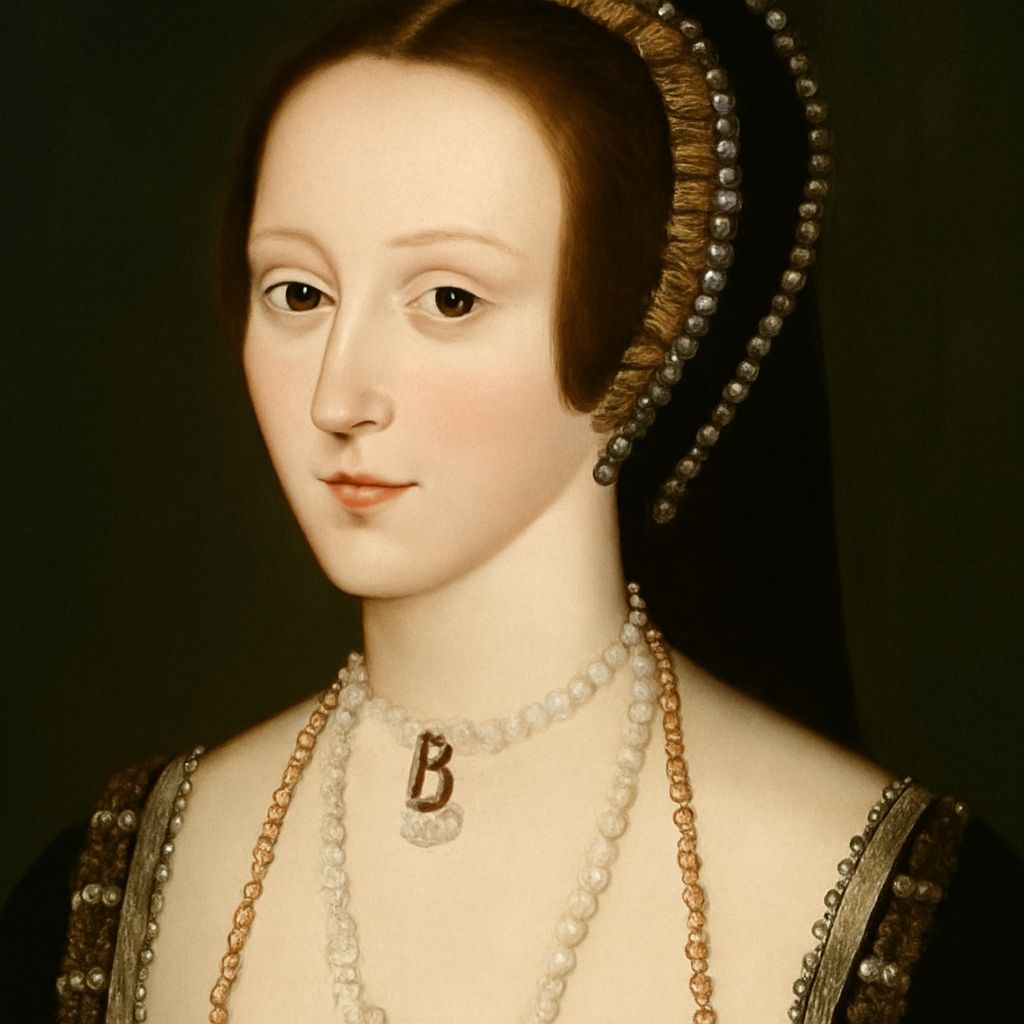
The idea that a single royal romance caused England’s break with Rome makes a complicated political upheaval look deceptively simple. Henry VIII’s determination to end his first marriage and marry Anne helped drive the crisis, but the settlement also depended on Parliament, church leaders, royal advisers, and arguments about sovereignty. Queen Anne Bolyn became a participant in that struggle as well as one of its most famous casualties.
Her rise and fall illuminate the insecurity of a court in which family alliances, religious commitments, and the succession were closely connected. The surviving evidence records the decisions that elevated her and the charges that destroyed her; it does not make every accusation true or reveal every private motive.
A courtier shaped by European courts
Born around the beginning of the sixteenth century, Anne grew up in a well-connected English family. Her exact birth year is uncertain. As a young woman she spent time at the court of Margaret of Austria in the Low Countries and then at the French court, where she acquired the experience expected of an accomplished courtier. Education, language, manners, and personal connections all mattered in a world where access to a ruler could shape a family’s prospects.
After returning to England, she served Catherine of Aragon, Henry’s first wife. By the mid-1520s the king was pursuing her. The story is often compressed into a private contest between attraction and resistance, but royal marriage had public consequences: it affected alliances, the legitimacy of children, and the stability of the dynasty.
Queen Anne Boleyn and the succession crisis
Henry’s marriage to Catherine had produced a surviving daughter, Mary, but no surviving son. An undisputed male heir mattered to him in part because the Tudor dynasty was relatively new and England had experienced destructive struggles over the crown. Henry argued that his marriage was invalid and sought an annulment, a declaration that it had not been valid in the first place. Catherine contested his claim, and the pope did not grant the decision Henry wanted.
The prolonged dispute gave the king and his advisers reason to challenge papal authority in England. Legislation and institutional changes gradually transferred authority over the English church to the crown. Anne supported religious reform and cultivated people sympathetic to it, although historians continue to debate the extent of her influence on particular decisions. The English Reformation was not the work of queen anne boleyn alone, nor did the break with Rome instantly create a settled Protestant church.
Henry and Anne married in 1533. Archbishop Thomas Cranmer declared Henry’s marriage to Catherine invalid that May, and Anne was crowned in June. Their daughter Elizabeth was born in September. A daughter did not provide the son Henry sought, but her birth was politically important: the new marriage and its offspring became central to a reshaped order of succession.
Faith, influence, and the limits of favor
A queen consort was not a reigning monarch, yet she could exercise influence through household appointments, patronage, and access to the king. Supporters sought her assistance; opponents could portray her prominence as a threat. At court, religion and politics overlapped, but they did not divide everyone neatly into two permanent camps. Anne’s support for reformers mattered alongside the work of officials such as Thomas Cromwell, whose interests did not always coincide with hers.
In 1534 Parliament recognized Henry as supreme head of the Church of England. This enlarged royal authority over religious institutions, while disputes continued over doctrine and the pace of change. Some who resisted the new settlement faced punishment. The story of Ann Bolyn therefore belongs to a wider history of coercion and institutional change, not simply to a royal household biography.
The court’s rewards were inseparable from its dangers. A queen’s position depended heavily on the king’s favor and on expectations that she would help secure the succession. Anne experienced pregnancy losses, and by 1536 the absence of a surviving son intensified the uncertainty around her marriage. Those circumstances help explain the pressures on her position, but they do not by themselves establish why individual advisers acted as they did.
Arrest, trial, and execution
In May 1536 Anne was arrested and taken to the Tower of London. She faced accusations including adultery, incest with her brother George, and treason. Several men were also accused. The court convicted her, and she was executed on May 19. The legal verdict is a historical fact; the alleged conduct is a separate question. The evidence presented and preserved does not justify treating the allegations as established truth, and many historians regard them as implausible or politically motivated.
The case against Anne Bolyen also demonstrates how a prosecution could serve the interests of a ruler who wished to remove a queen and remarry. That does not prove a complete account of who conceived every charge or exactly how the case was assembled. The surviving record leaves room for disagreement about the roles of Henry, Cromwell, and other courtiers. Henry married Jane Seymour later that month.
A legacy shaped by later generations
The daughter of Ann Boelyn became Elizabeth I in 1558, making her mother’s story part of the history of a long and consequential reign. Yet later portraits of Anne have often reflected the concerns of those who produced them. Religious opponents depicted her as a corrupting influence, while sympathetic accounts could emphasize Protestant faith or cast her primarily as a martyr. Novels and screen dramas have added motives and conversations for which evidence is thin.
Those images are useful evidence of changing memory, but they are not interchangeable with contemporary records. A careful account of Anne, the queen consort, holds together what can be established—her marriage, her public position, her trial, and her death—while recognizing that court politics and the evidence of private lives remain harder to reconstruct.