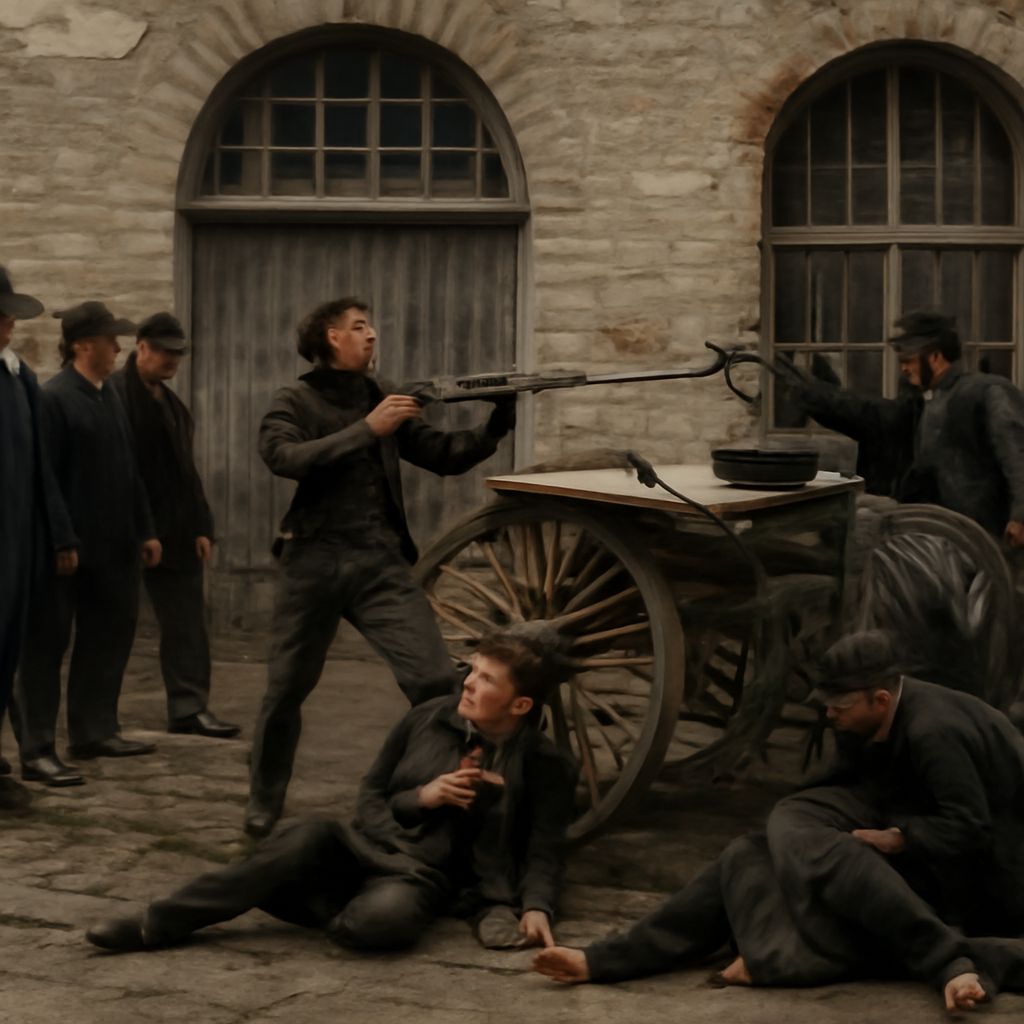
The attack on Harpers Ferry did not begin the Civil War, although it became one of the events that made compromise over slavery more difficult. In October 1859, abolitionist John Brown led an armed attempt to strike at slavery by seizing a federal weapons site in Virginia. Brown’s raid at Harpers Ferry failed militarily, but his trial and execution gave the confrontation a national audience.
For some Americans, the raid exposed the violence required to defend slavery; for others, it seemed proof that their communities faced attack. Those reactions grew out of an existing conflict over slavery’s future, not a dispute created by a single man.
John Brown’s Raid: An Antislavery Plan
Brown had long opposed slavery and believed that force could be justified to end it. Before the raid, he had taken part in violent conflict in Kansas, where proslavery and antislavery factions fought over whether the territory would permit slavery. At Pottawatomie Creek in 1856, Brown and his associates killed five proslavery settlers. His commitment to emancipation and his willingness to kill were both central to understanding his later action.
He developed a plan to seize weapons at Harpers Ferry, then part of Virginia and now in West Virginia. Brown hoped to arm enslaved people and encourage a movement against slavery in the surrounding region and beyond. The federal armory manufactured weapons, while an arsenal stored arms; their location made the town a conspicuous target.
The plan depended on gathering support under difficult and uncertain conditions. Abolitionist Frederick Douglass knew of Brown’s intentions but declined to join him, as the National Park Service’s Douglass chronology records. Brown’s followers included Black and white men, and their participation reflected a range of experiences and commitments within the antislavery movement.
The Attack and Its Defeat
On the night of October 16, Brown and a small group crossed from their Maryland base into Harpers Ferry. They seized parts of the federal armory complex, cut telegraph wires and took hostages. The group also sought support among enslaved people in the area. The larger uprising Brown anticipated did not materialize.
The town’s residents and local militia responded with force. As fighting spread, some raiders were killed and others were trapped. Among those killed early was Heyward Shepherd, a free Black railroad employee. His death is a reminder that the violence threatened people who were not part of Brown’s force as well as those directly defending the town.
Brown and surviving men took refuge with hostages in the armory’s fire engine house. U.S. Marines under the command of Robert E. Lee arrived, and on October 18 they stormed the building. Brown was wounded and captured. The National Park Service’s raid timeline records sixteen deaths during the fighting, including ten of Brown’s men; some participants escaped, while others were captured later.
John Brown’s raid on Harpers Ferry therefore fell far short of its immediate military purpose. Its failure, however, did not bring public argument over its purpose or its consequences to an end.
Trial and Execution
Virginia authorities tried Brown at Charles Town. The charges included murder, treason against Virginia and conspiring with enslaved people to rebel. His trial began on October 27; the jury convicted him, and he was sentenced to death. Brown was hanged on December 2, 1859. Six other captured members of the party were also tried and executed.
Brown used the courtroom to explain his antislavery purpose. His statements and his conduct before execution circulated widely, allowing sympathizers to portray him as a man willing to die for freedom. That image did not erase the killings or require all opponents of slavery to approve his methods. It did give abolitionists a powerful public figure around whom to organize mourning and argument.
The John Brown raid on Harpers Ferry also became the subject of official investigation. A U.S. Senate investigation collected testimony about the expedition and its connections. The record provides evidence of what investigators asked and witnesses said, alongside the political pressures surrounding the inquiry.
Why Reactions Were So Divided
Many white southerners saw an attempted attack on slavery as a threat to their security and to an economic and social order built on the forced labor of enslaved people. Some interpreted northern sympathy for Brown as evidence of a broader plot. Slaveholding states strengthened vigilance and fears of insurrection became a force in sectional politics.
Northern opinion was not uniform. Some abolitionists honored Brown as a martyr; others opposed slavery but rejected his methods or feared their consequences. Republican leaders generally distanced themselves from the raid. Sympathy for its antislavery aim did not mean that all northerners supported a violent uprising, just as fear of the attack did not make every southern account of a coordinated northern plot accurate.
John Brown’s raid on Harpers Ferry intensified distrust at a moment when arguments over the expansion of slavery, political representation and federal authority were already bitter. In Harpers Ferry, 1859 brought an armed confrontation; across the country, the meaning assigned to it helped harden opposing views.
The 1860 presidential election and the secession of southern states followed. War began in April 1861. The 1859 Harpers Ferry raid led by John Brown was one consequential episode in the conflict over slavery, not a sufficient explanation for that conflict or for every decision that led to war.