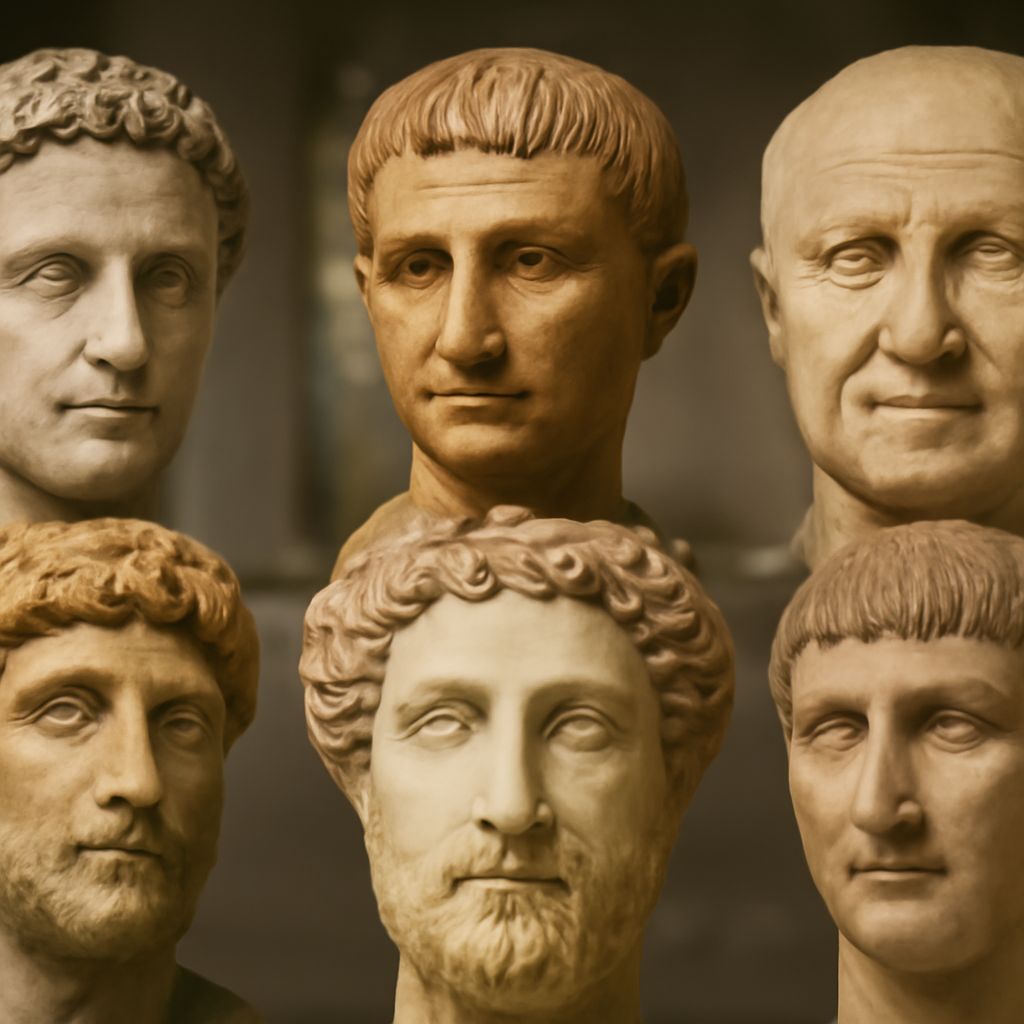
What made a ruler of Rome an emperor? The answer was a combination of military command, public authority and recognition by powerful groups, rather than a single office with an unchanging set of rules. Rome’s imperial rulers governed for centuries, and the balance among the Senate, the army and the imperial administration changed over that time.
Augustus created a durable framework after civil war, but his successors faced recurring questions: who could claim power, who would support that claim, and how could one ruler govern a vast territory? The institution evolved as each generation answered them under different conditions.
Emperors of Rome: Augustus and the Principate
Rome had been a republic, with elected magistrates and a Senate composed of elite statesmen. After the civil wars of the first century B.C., Octavian emerged as the dominant military leader. In 27 B.C., the Senate granted him the title Augustus. He preserved republican offices and presented himself as princeps, or first citizen, while holding exceptional powers and commanding the armies that underpinned his position.
Historians call the early imperial system the Principate. The term helps describe a regime in which one man held preeminent authority while republican institutions continued to function. Augustus’ position was not simply a hereditary crown established by a single constitutional document. His authority came from a collection of powers, political relationships and control of force. The Metropolitan Museum of Art’s account of Augustan rule also shows how religious roles and public monuments represented that authority.
The Senate still debated, administered some provinces and conferred honors. Its cooperation lent legitimacy to imperial rule, and its members filled important offices. Yet it operated under the shadow of a leader with superior military resources. A Roman emperor could consult senators and rely on their expertise without surrendering ultimate control over major decisions.
The Army’s Power to Make and Unmake Rulers
Soldiers defended frontiers and enabled emperors to suppress rivals. In return, rulers sought their loyalty through pay, rewards and attention to military needs. The connection made armies indispensable but also politically consequential: a commander with troops could challenge the person already in power.
The year A.D. 69 illustrated the danger. After Nero’s death, several claimants competed, and civil war ended with Vespasian establishing a new dynasty. An army’s proclamation could help a claimant become emperor of Rome, but victory and recognition across the empire remained necessary to consolidate the position.
The third century brought a more prolonged period of rapid succession and military pressure. Generals rose through armies stationed far from Rome, while invasions and internal conflicts stretched resources. The Metropolitan Museum’s overview describes the importance of military support to rulers between A.D. 235 and 284. This dependence did not mean every soldier chose policy; it meant that an emperor who lost crucial military backing could face a rival with the means to fight.
Succession: Family, Adoption and Force
There was no consistently applied rule guaranteeing a peaceful transfer. A reigning ruler might promote a son, adopt an heir or elevate a relative, seeking to make the choice clear before his death. Tiberius, Augustus’ adopted stepson, succeeded him in A.D. 14. Later rulers also used adoption to prepare successors, although these arrangements depended on political relationships as well as legal acts.
Upon the death of an emperor, Rome could face competing claims if the expected successor lacked support. Senators, guards in the capital, provincial armies and leading officials could all matter. Recognition and access to force made a claim credible, while family connection supplied an important argument for continuity.
The emporers of Rome therefore did not all inherit power in the same way. Some succeeded through carefully prepared dynastic arrangements; others emerged from civil conflict. Even an apparently orderly succession was a political achievement, requiring influential groups to accept a particular candidate.
From One Capital to a Larger Administration
An emperor could not personally collect every tax or decide every provincial dispute. Governors, military commanders, financial officials and local elites carried imperial decisions into communities across the Mediterranean. They transmitted revenue and information back to the center, giving the ruler capacity to act beyond the city of Rome. The Senate remained important, but imperial appointees and household officials also acquired substantial responsibilities.
Imperial authority depended on persuasion as well as coercion. Coins, statues and public ceremonies represented a ruler as victorious, capable or favored by the gods. These images communicated claims about rule to audiences who would never meet him. A portrait or inscription is consequently evidence of how power was presented, though it cannot on its own prove that subjects believed the message.
Diocletian, who came to power in A.D. 284, reorganized rule in response to the difficulties of governing and defending the empire. His tetrarchy, meaning rule by four, paired two senior emperors with two junior colleagues who were intended to succeed them. The arrangement divided responsibilities geographically and provided a planned succession, but later conflicts showed that a formal design could not eliminate rivalry.
What Changed in the Later Empire?
Later Roman rulers presided over a more elaborate court and administrative structure. A ruler of the Roman Empire depended on that network to transmit decisions across its provinces. Under Constantine, imperial support for Christianity changed the relationship between political authority and religion, and Constantinople became an important imperial capital. The Senate remained part of Roman political life, though its position differed from that of the old republican Senate.
The emperors of Rome continued to require resources, capable officials and military support, even as the language and organization of power changed. The western imperial line conventionally ends in A.D. 476, when Romulus Augustulus was deposed. The eastern empire continued, governed from Constantinople.
Was Julius Caesar the first emperor? No. He was a powerful Roman dictator whose career helped end the Republic; Augustus is conventionally regarded as the first emperor.