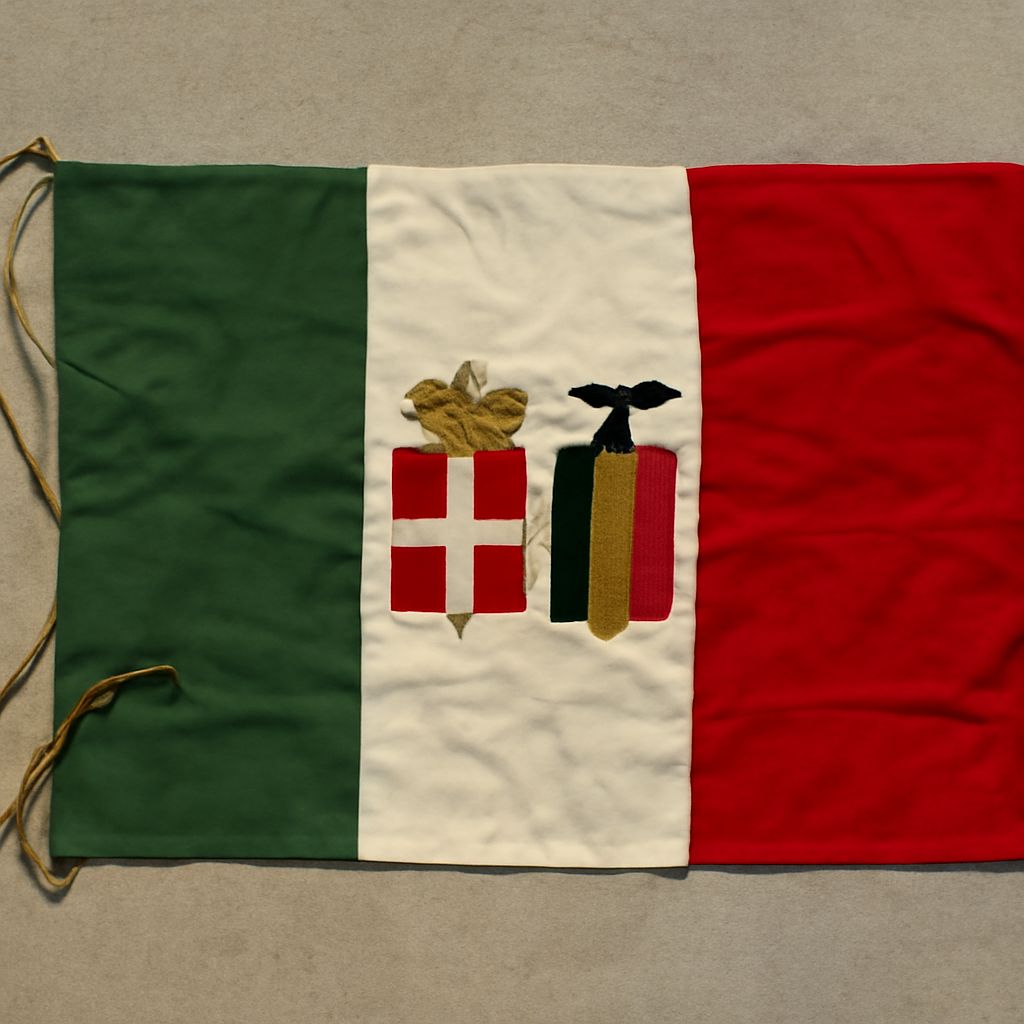
The Fascist Italy flag holds a significant place in history, representing a turbulent era under Benito Mussolini’s regime. This flag, often referred to as the Italian fascist flag, symbolizes the ideals and authority of fascism in Italy from the early to mid-20th century. Understanding its design, symbolism, and role provides insight into its impact and legacy.
Historical Background
Fascism emerged in Italy after World War I, amidst social unrest and economic instability. Benito Mussolini founded the National Fascist Party in 1919, which gained momentum, leading to his rise to power in 1922. The fascist regime sought to create a strong centralized state, emphasizing nationalism, militarism, and expansionism.
The flag of Fascist Italy was introduced as a powerful symbol of this new political movement. It was used to convey the regime’s ideals and to unite the Italian people under a singular national identity.
Design and Symbolism
The Italian fascist flag featured the traditional Italian tricolor of green, white, and red. However, it included a distinctive emblem—the fasces—superimposed on the white stripe. The fasces, an ancient Roman symbol consisting of a bundle of rods and an axe, represented authority and strength. It signified unity and power, echoing the regime’s authoritarian rule.
This emblematic addition to the flag served to reinforce Mussolini’s vision of a rejuvenated Roman Empire and his aspirations for Italy to become a dominant force in Europe. The combination of the tricolor with the fasces symbolized both continuity with Italy’s past and the revolutionary ideals of fascism.
Role During Mussolini’s Regime
During Mussolini’s rule, the fascist flag became a prominent feature in public life. It was displayed at official events, parades, and government buildings, symbolizing the regime’s control and the fascist ideology. The flag served as a tool for propaganda, rallying support for the regime’s policies and objectives.
The flag also played a role in Italy’s foreign policy ambitions, accompanying military campaigns and efforts to expand Italian territories. It was a constant reminder of the regime’s commitment to restoring Italy’s greatness, as envisioned by Mussolini.
Legacy and Impact
The legacy of the Fascist Italy flag is complex and contentious. After Mussolini’s fall from power in 1943, the flag became a symbol of a dark period in Italian history. Today, it is often associated with the oppressive nature of the regime and its aggressive policies.
Despite its negative connotations, the flag remains a subject of interest for historians and scholars studying the rise and fall of fascism in Italy. It serves as a cautionary symbol of the dangers of totalitarianism and the impact of authoritarian rule on a nation’s identity and history.
Understanding the Fascist Italy flag and its symbolism offers valuable lessons in the importance of recognizing and challenging oppressive ideologies. It remains a historical artifact that provides insight into Italy’s past and the enduring influence of symbols in shaping political narratives.