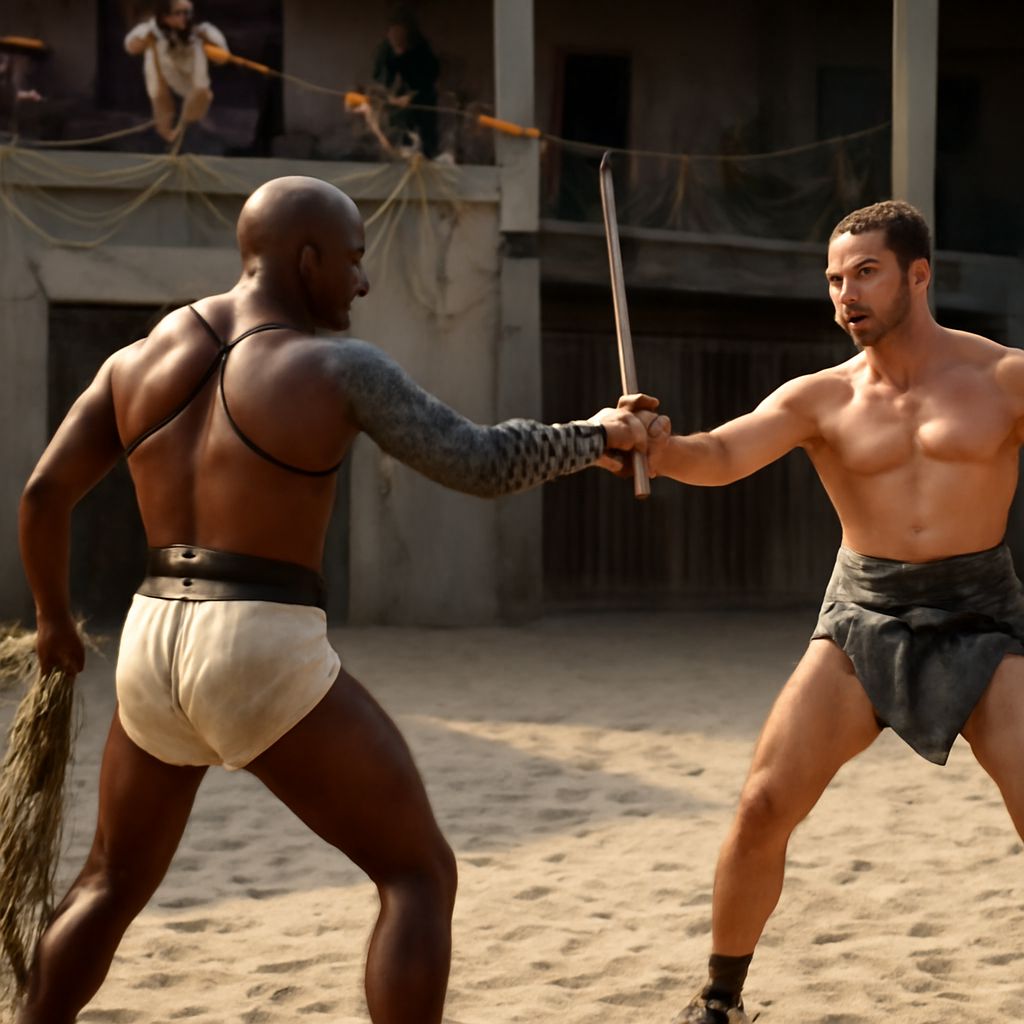
In 73 BCE, a group of gladiators escaped from a training school at Capua with kitchen implements in their hands. Their escape grew into a war that occupied Roman armies for nearly two years. At its center was Spartacus, an enslaved fighter whose life and rebellion became part of the history of the late Roman Republic.
The historical story of Spartacus is known chiefly through accounts written long after the fighting. Those narratives identify a leader and trace a campaign across Italy, but they leave his own words and many details of his life unrecorded. They nevertheless show how a local escape became a challenge to Roman power.
Spartacus, the Real Story of the Escape
Who was Spartacus before the revolt? Appian, writing in his Civil Wars, calls him a Thracian, meaning a person from a region broadly associated with the eastern Balkans. Appian says he had served with the Romans, was taken prisoner and sold as a gladiator. Plutarch, in his life of the Roman commander Crassus, also identifies him as Thracian. The identity of Spartacus as a Thracian is shared by both authors, though neither provides a secure modern-style biography of his early years.
A gladiator was trained to fight for public entertainment. At the school in Capua, the fighters were held under compulsion. Plutarch says a larger escape plot was discovered, but 78 men got away, seized weapons, and made for a defensible position near Mount Vesuvius. Appian gives the initial group as about 70. Both describe a small beginning, even if the precise count differs. The true history of Spartacus thus starts with an escape, rather than an army already assembled.
For Spartacus, the real story of the war began with a fight to remain free. Plutarch reports that the fugitives chose leaders, including Spartacus and Crixus, and were joined by others escaping slavery. A Roman force tried to contain them on Vesuvius. According to Plutarch, the rebels made ladders from vines, descended a steep slope the Romans had left unguarded, and attacked their camp. Weapons taken from defeated opponents helped turn fugitives into an armed force.
A Revolt Becomes a War
In 72 BCE, Roman commanders faced a much larger rebellion. Plutarch says Spartacus intended to lead his followers toward the Alps so they could return to their homelands, but that his army did not follow that plan. Appian describes fighting involving both Roman consuls, the Republic’s highest elected magistrates, and says Crixus and a separate force were defeated. The accounts differ in emphasis and sequence, so the reason the rebels did not leave Italy cannot be established with certainty from either narrative.
The uprising also concerns people whose names are largely missing from the record. Enslaved people joined the uprising as it moved through Italy, and the rebels defeated several Roman forces. Appian gives a figure of 120,000 for the rebels at one point; that is his estimate, not a number that can be independently verified. Feeding and moving such a force would have been a major undertaking, especially while facing Roman armies and gathering followers from different places.
For Spartacus, ancient Rome was both the power that held gladiators in bondage and the state whose armies his forces repeatedly defeated. The Republic’s wealth and expansion depended in part on enslaved labor, obtained through warfare and other forms of coercion. People held as property worked in households, agriculture, mines, and other settings. An uprising on Italian soil exposed the violence required to sustain that system and the danger Rome faced when the people it enslaved organized against it.
Crassus and the Defeat of the Rebels
The Senate then gave Marcus Licinius Crassus command against the revolt. He brought greater resources and discipline to the campaign. Plutarch recounts that after troops under his subordinate Mummius attacked against orders and were defeated, Crassus used decimation: a punishment in which selected soldiers were killed by their own comrades. The episode illustrates the severity with which Roman commanders could enforce obedience within their own ranks.
The Spartacus story then moved south. Plutarch says the rebels reached the southern tip of Italy and arranged with pirates for passage to Sicily, but the pirates took their payment and sailed away. Crassus built a fortified barrier across the region to confine them; the rebels broke through part of it. A separate group later split from Spartacus and was defeated. The remaining force was eventually brought to battle against Crassus.
Plutarch describes Spartacus fighting fiercely and being overwhelmed in the final battle. Appian says his body was not found. Appian also reports that 6,000 captured rebels were crucified along the road between Capua and Rome. Spartacus was a leader of the defeated rebellion, and the mass execution was a public demonstration of punishment after a war that had threatened the Republic’s control over enslaved people. The revolt ended in defeat; slavery remained a central institution of Roman society.
The Historical Leader and Later Symbols
The account of Spartacus in ancient Roman writing survives through authors concerned with Roman commanders and military events. It offers no manifesto by Spartacus establishing a program to abolish slavery throughout the Republic. His own motives beyond the immediate struggle for freedom are consequently harder to reconstruct than the course of the campaign.
Later generations gave his name new meanings. In Germany during World War I, the revolutionary group associated with Rosa Luxemburg issued the Spartacus Letters; the Rosa Luxemburg Foundation traces the group’s later name to those publications. The name invoked resistance in a new political setting, not evidence that the ancient leader held a twentieth-century socialist program.
The 1960 film Spartacus, starring Kirk Douglas, created another influential image. Its screenplay was publicly credited to Dalton Trumbo, a blacklisted writer, as the American Film Institute records. The film is a dramatic interpretation, with characters and scenes shaped for its own time. Was Spartacus himself crucified as in the film? The surviving ancient accounts place him in the final battle; Appian says his body was never found.