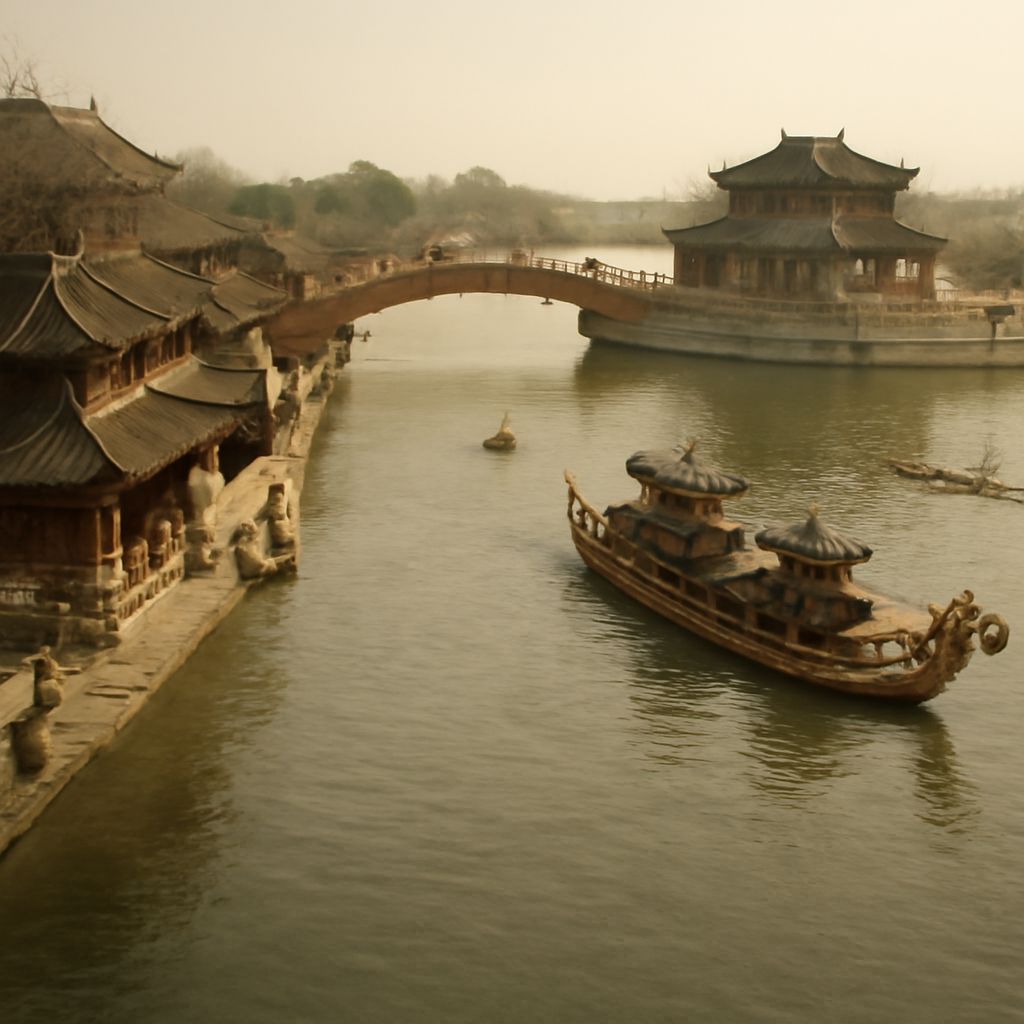
How did an imperial Chinese dynasty preside over commercial growth while losing much of its northern territory? The Song rulers governed from 960 to 1279, but their experience changed sharply in 1127, when the earlier northern court lost its capital and a successor regime took shape in the south. Strong civil institutions and economic resources helped sustain the state; they did not eliminate military threats from neighboring powers.
The transition divided one ruling house into two periods. Its governments inherited a long Chinese imperial tradition, adapted it through an expanding bureaucracy and operated within a political landscape that included powerful rival states.
Northern Song Dynasty: A New Imperial Order
The Song dynasty dates from 960, when the general Zhao Kuangyin became emperor, later known as Taizu. The preceding Tang dynasty had fallen in 907, after which competing regimes ruled different territories. Taizu and his successors brought much of China under their authority, though important areas to the north and northwest remained under other states. The Northern Song dynasty is conventionally dated from 960 to 1127, with its capital at Kaifeng.
The court sought to prevent regional military leaders from dominating the state as they had during preceding conflicts. It placed greater emphasis on civilian administration and appointed officials to manage provinces, revenue and military affairs. This did not remove the need for armies: the state maintained large forces while negotiating with neighbors and paying agreed annual transfers to some of them.
A bureaucracy is a system of appointed officials who carry out government business. Song rulers relied increasingly on scholar-officials, men trained in classical learning and selected in significant numbers through competitive examinations. The Metropolitan Museum of Art describes the prominence of this educated administrative elite and its role in cultural life.
Examinations offered a route to office that was not limited to hereditary aristocratic title. Access remained unequal, however: years of study required resources, and established families could provide education and connections. An examination result was a credential within a larger political system, not a guarantee that everyone could compete on equal terms.
Government, Debate, and Reform
Imperial authority rested on the emperor and his court, but governing required many officials to interpret policy and manage local affairs. Their tasks included collecting taxes, maintaining records and applying law. Officials also advised the throne, and disagreement over policy could become a struggle between court factions.
One prominent reformer, Wang Anshi, proposed measures in the eleventh century intended to strengthen state finances and address social and military problems. His initiatives and their implementation provoked determined opposition. The dispute shows that a state built around educated officials could still disagree intensely about how much government should intervene and how its programs should work.
The Move South in 1127
The Jurchen-led Jin state became the decisive northern rival. Jin forces captured Kaifeng in 1127 and took the reigning emperor and his predecessor prisoner. A member of the ruling family continued the government farther south, eventually establishing the court at Lin’an, present-day Hangzhou. Historians call this phase the Southern Song dynasty, dated 1127–1279.
The change was more than a move between capitals. The court lost control of much of north China, including territories with deep political and cultural importance, while retaining a substantial southern realm. Jin controlled much of the north; the two states fought and negotiated, including a peace settlement in 1141. Borders and relationships changed over time, so a single map cannot represent all three centuries of Song rule.
The Smithsonian’s chronology places the 1127 transition within the larger sequence of Chinese dynasties. The continuing court retained imperial institutions and a claim to legitimacy even after the loss of the old capital.
Agriculture, Markets, and Technology
Both phases saw substantial economic activity. Agricultural improvements, including the wider use of fast-ripening rice in suitable southern regions, supported population growth. Farmers supplied cities and markets through river and canal networks. Local conditions varied, and prosperity was not distributed evenly, but the scale of exchange gave the government an important tax base.
Urban centers supported merchants, artisans, officials and consumers. Expanded commerce encouraged new financial practices: the state issued paper money in the twelfth century, alongside other forms of currency. The National Museum of Asian Art connects population growth, agricultural techniques and trade to the period’s economy.
Printing helped circulate texts, including works used in education and administration. Gunpowder weapons developed in warfare, while improved navigation contributed to maritime activity. Such developments had earlier histories and continued afterward; their importance during this period lies in how they were adapted and used, rather than in a claim that every innovation began at once.
The Song dynasty facts visible in surviving paintings, ceramics, printed works and official records also point to active cultural patronage. Scholar-officials wrote poetry and practiced calligraphy, while court artists and craftspeople worked for different patrons and audiences. Objects reveal cultural priorities, although surviving elite works tell only part of the story of everyday life.
Conquest and the Yuan Transition
The Mongols defeated the Jin in 1234 and later turned against the southern court. Fighting continued for decades before the final Song defeat in 1279. Kublai Khan had proclaimed the Yuan dynasty in 1271; the conquest brought the former Song territories into a Mongol-ruled imperial order. The Metropolitan Museum’s chronology shows the overlap between the two regimes rather than presenting the transition as an instantaneous replacement.
The fall ended the ruling house, but institutions, technologies and cultural traditions continued to influence later Chinese history. The shift from the northern court to the southern regime and then to Yuan rule illustrates how an enduring administrative tradition could survive profound changes in territory and political power.