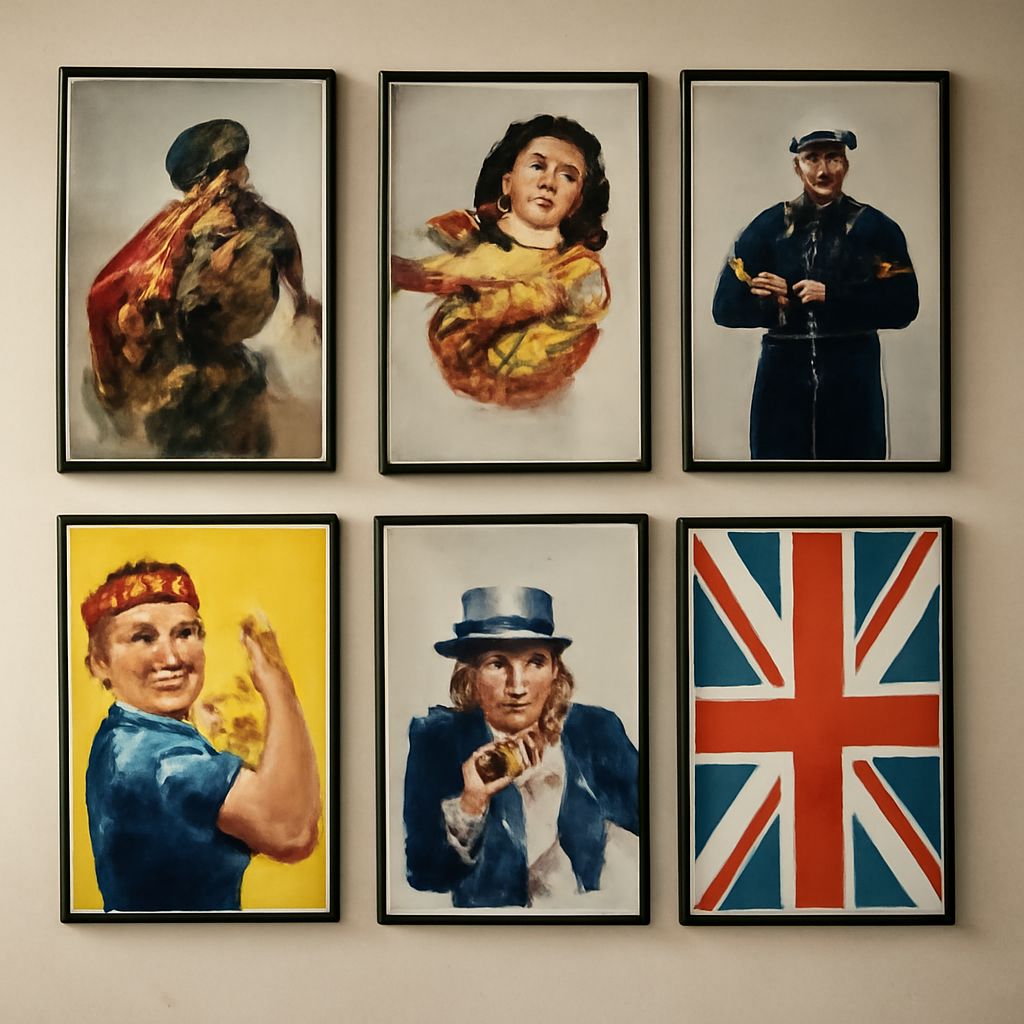
World War I and World War II posters turned government policy into short public instructions: enlist, buy bonds, grow food, work harder, keep silent, or endure. A propaganda poster WW2 governments commissioned could address civilians as directly as soldiers.
Each WWI propaganda poster used a limited set of appeals, but the target was often clearer: young men for recruitment, households for finance and conservation, and citizens for morale. WWII posters expanded those appeals across factories, farms, offices, and homes.
World War I: WWI Propaganda Poster Examples
Recruitment posters made military service a personal duty. Alfred Leete’s British poster Your Country Needs You, produced for the Parliamentary Recruiting Committee, shows Lord Kitchener pointing at the viewer. Its direct gaze and command addressed British men of military age, turning national need into an immediate decision: enlist.
James Montgomery Flagg’s American I Want You for U.S. Army poster used Uncle Sam’s pointing finger, white hair, and stern expression. The U.S. Army was the sponsor, and the intended audience was potential male recruits. The word “you” made a national war feel like a private obligation.
Finance posters asked civilians to support the war without wearing a uniform. The U.S. Treasury’s Liberty Loan campaigns used slogans such as Beat back the Hun with Liberty Bonds, combining a frightening enemy image with a clear financial action: buy government bonds.
Production and morale appeals also entered domestic life. U.S. Food Administration campaigns presented food as a military resource, while National War Garden Commission posters encouraged citizens to grow vegetables. Their message was that saving or producing food counted as patriotic service.
World War II Propaganda Posters: Representative Examples
WWII posters kept the recruitment formula but widened the range of people addressed. American Army recruiting designs continued to use Uncle Sam, while British posters urged men and women to serve in the armed forces, civil defense, transport, and other essential roles. Duty now included many kinds of wartime labor.
The famous We Can Do It! poster was made by J. Howard Miller for Westinghouse Electric & Manufacturing Company in 1943. Its sponsor was a private company, and its original audience was female factory workers. The raised arm, rolled sleeve, and confident expression supported a practical request: meet the demands of war production.
Britain’s Dig for Victory campaign, led by the Ministry of Food, addressed civilians who could grow food at home or in community plots. Gardens, vegetables, and healthy families replaced the battlefield as symbols of national defense. The requested action was simple: produce food and reduce pressure on supplies.
Finance remained central. U.S. Treasury bond and stamp posters addressed families and workers, often showing soldiers, flags, children, or threatened homes. Security campaigns such as Loose Lips Might Sink Ships addressed civilians with another direct action: keep military information secret.
Comparing Duty, Fear, Work, and Finance Appeals
Duty: WWI recruitment posters usually defined duty as enlistment by able-bodied men. WWII campaigns still praised military service, but they also treated factory work, nursing, farming, civil defense, and office work as forms of national duty.
Fear: WWI posters often used the “Hun,” invasion, dishonor, or the shame of failing one’s family. WWII designs added fears of bombing, espionage, shortages, and betrayal. A slogan such as Careless Talk Costs Lives made an ordinary conversation appear potentially fatal.
Sacrifice: Both wars linked private hardship to victory. WWI posters asked people to accept enlistment, rationing, and financial risk. WWII posters more visibly organized sacrifice around mass participation: ration food, conserve materials, work longer, and tolerate restrictions.
Work and finance: In both wars, bond posters converted money into weapons and supplies. WWII imagery gave industrial labor a stronger visual presence, using confident workers, machines, uniforms, and production targets to show that factory output was part of the front line.
Across both periods, slogans supplied the verb. “Enlist,” “buy,” “save,” “grow,” “work,” and “keep silent” tell viewers what to do, while a pointing hand, central face, national flag, soldier, child, or factory reinforces that instruction. The design reduces a complicated policy to one memorable choice.
How to Interpret a Wartime Poster
- Identify the sponsor. Look for a government department, army, treasury, ministry, company, or civic organization. The sponsor reveals whether the poster seeks soldiers, money, labor, food, secrecy, or morale.
- Define the audience. Ask who is being addressed: recruits, parents, women workers, farmers, bond buyers, or the general public. Clothing, family scenes, workplace settings, and pronouns often provide the clue.
- Find the requested action. Read the slogan as an instruction. A poster may not say “act now,” but its command, question, or accusation usually points toward enlistment, purchase, conservation, production, or silence.
- Read the visual hierarchy. The largest face or object is usually the emotional focus. A pointing figure creates personal pressure, an enemy creates fear, a child creates protective responsibility, and a machine or crop makes production visible.
- Notice what is missing. Posters simplify war. Comparing their heroic symbols and confident slogans with the historical setting helps reveal how persuasion made danger, cost, and government policy appear manageable.