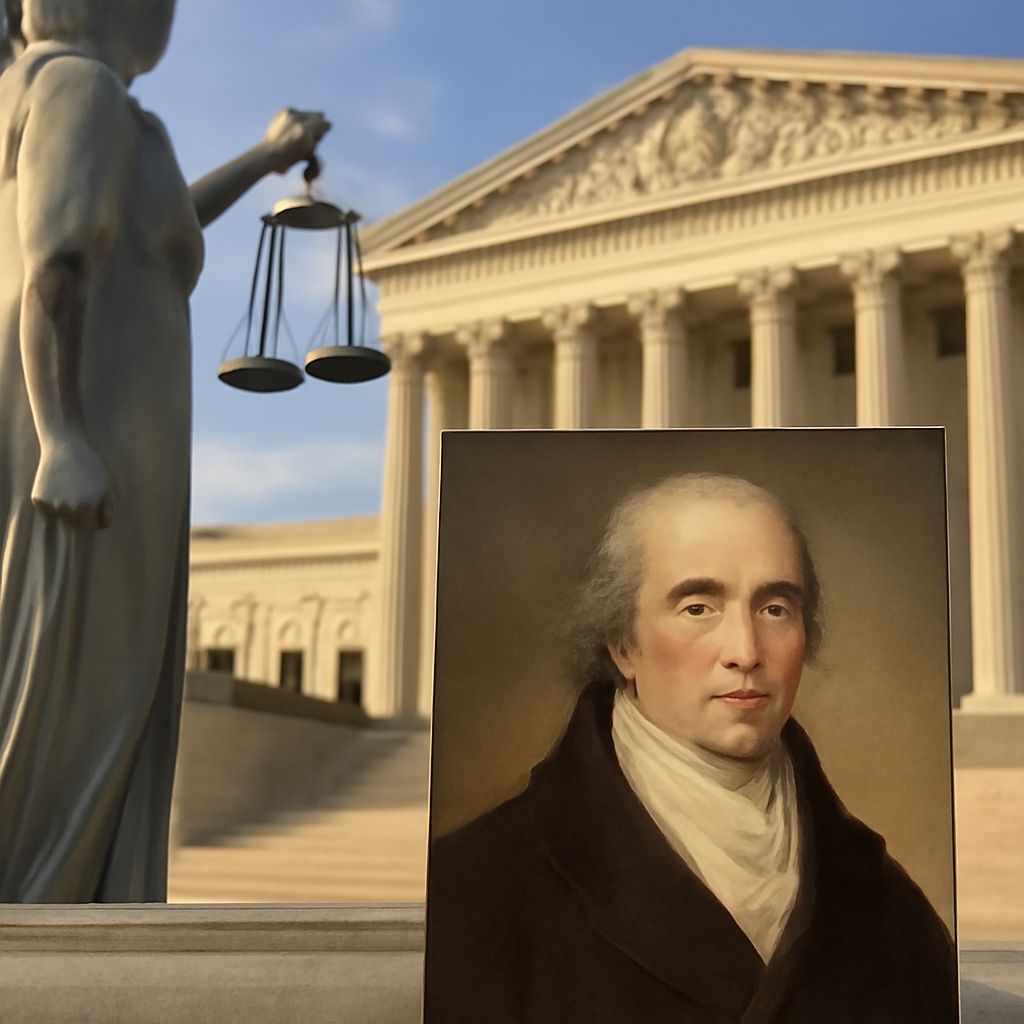
The Supreme Court did not order James Madison to deliver William Marbury’s commission, even though it concluded that Marbury had a right to it. In the 1803 decision usually styled Marbury v. Madison, Chief Justice John Marshall explained that the Court lacked authority to issue the requested order in the proceeding before it.
The dispute between Madison and Marbury arose during a change of presidential administrations. It is remembered for judicial review, the power of courts to decline to apply a law that conflicts with the Constitution. Its reasoning also turns on a narrower question: which cases the Supreme Court may hear first, rather than on appeal.
Madison v Marbury: A Commission Caught in a Political Transition
In the final days of John Adams’s presidency, the Federalist administration filled numerous offices. Marbury was appointed a justice of the peace in the District of Columbia. His commission, the document recording his appointment, was signed by Adams and sealed, but it was not delivered before Thomas Jefferson took office in March 1801.
Jefferson’s administration declined to deliver the outstanding commission. James Madison, the new secretary of state, was the official from whom Marbury sought it. Marbury and other appointees asked the Supreme Court directly for a writ of mandamus, an order requiring an official to perform a legal duty.
The dispute is commonly cited as Marbury v. Madison, with Marbury as the applicant and Madison as the official named. Madison v Marbury concerned whether the secretary of state could be ordered to deliver the commission. Its political setting matters because the requested order would have directed a member of Jefferson’s administration to act.
The Court’s Three Questions
In the Court’s opinion, Marshall proceeded through three questions in order: Did Marbury have a right to the commission? If so, did the law provide a remedy? And if a remedy was available, could the Supreme Court issue it in this proceeding?
First, the Court held that the appointment was complete once the president had signed the commission and the seal had been affixed. Delivery of the paper was evidence of the appointment, but, in Marshall’s account, it was not the act that created the right. Withholding the commission therefore violated Marbury’s vested legal right.
Second, Marshall reasoned that a legal right normally carries a legal remedy. He distinguished duties imposed by law, where an individual right could be enforced, from political or discretionary executive acts entrusted to officials’ judgment. Because delivery of a completed commission was treated as a duty owed to Marbury, mandamus was an appropriate kind of remedy in principle.
Third came the decisive jurisdictional issue. Original jurisdiction means authority to hear a case first; appellate jurisdiction means authority to review a decision made elsewhere. Marbury filed directly in the Supreme Court. The Court had to determine whether the Constitution allowed it to exercise original jurisdiction over this request.
Why Jurisdiction Defeated the Request
The Judiciary Act of 1789 authorized the Supreme Court to issue writs of mandamus in certain circumstances. Marshall read section 13 as giving the Court power to issue such a writ in an original proceeding of Marbury’s kind. Article III of the Constitution, however, identifies categories of cases in which the Supreme Court has original jurisdiction; Marbury’s request did not fall within them.
The Marbury vs Madison ruling treated the statute, so interpreted, as an impermissible expansion of the Court’s original jurisdiction. Marshall concluded that Congress could not enlarge that constitutional allocation by ordinary legislation. Because the Constitution prevailed over the conflicting provision, the Court could not issue the requested writ.
This result explains the apparent contradiction in the decision: a right and a potentially suitable remedy did not give this particular court authority to grant that remedy in the particular procedural posture. The judgment denied the application. It did not order Madison to hand over the commission.
Judicial Review and Its Limits
Judicial review is the practice of evaluating government action against a higher law and refusing to enforce a conflicting rule in a case. The Marbury vs Madison 1803 decision is a foundational statement of federal judicial review, especially of an act of Congress. Marshall reasoned that a written Constitution would lose its governing force if ordinary legislation could override it and courts had to apply the conflicting statute.
The decision did not invent every idea of judicial review from nothing. The relationship between constitutional limits and judicial duty had been debated before 1803, and courts had considered similar questions in other settings. Nor does the case mean judges may resolve every political disagreement: courts must have a case within their jurisdiction, and constitutional interpretation develops through later decisions.
Madbury vs Madison illustrates how a dispute over an appointment became a statement about constitutional priority. Its importance rests on the Court’s reasoning about the relationship between a statute and the Constitution. The Court’s reading of the Judiciary Act and its choice to address the right and remedy before jurisdiction have also attracted scholarly debate.
Why did Marbury not receive the order despite the Court’s recognition of his right? Marshall concluded that the Supreme Court lacked original jurisdiction to issue it in that proceeding, and that Congress could not supply the missing authority through the statute as the Court read it.