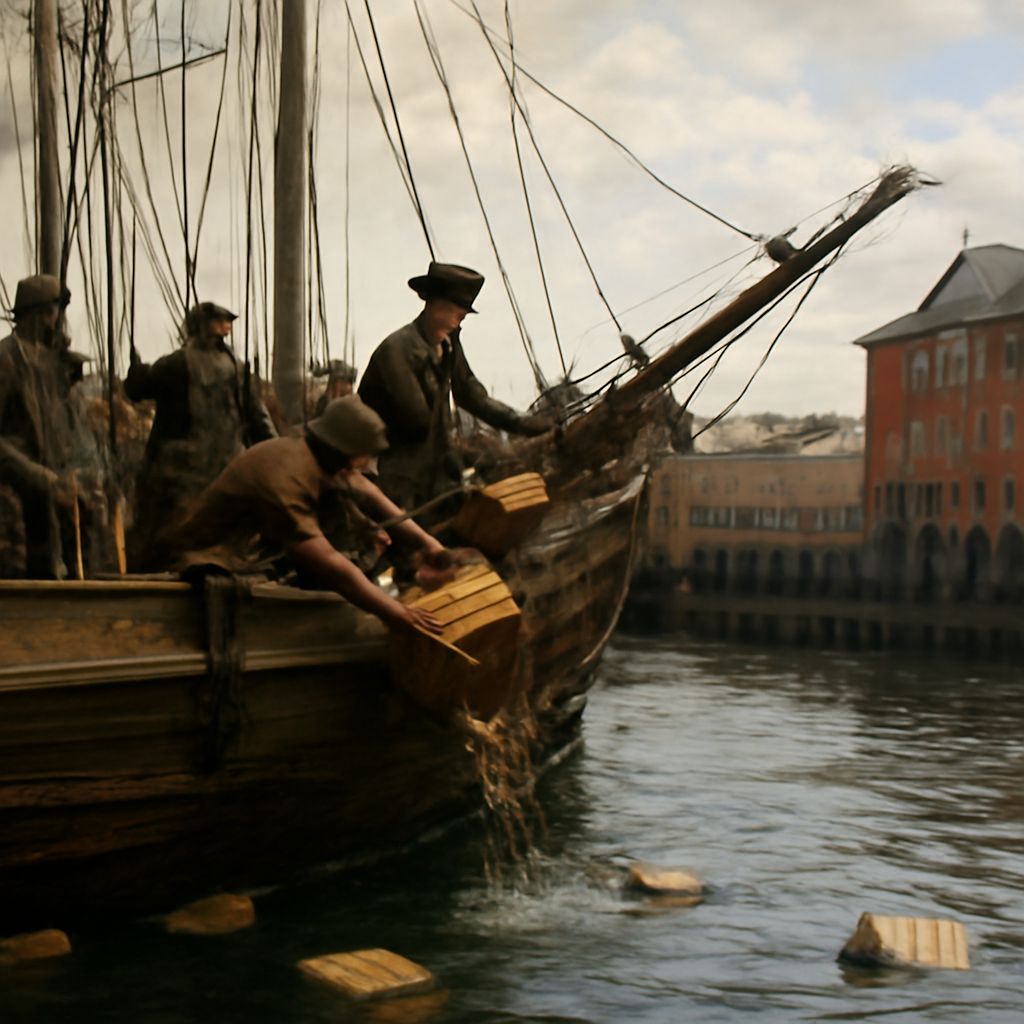
Why did a shipment of tea become a crisis for the British Empire? On December 16, 1773, a group of colonists destroyed East India Company tea in Boston Harbor after a dispute over taxation and Parliament’s authority. The Boston protest was about the terms on which the colonies were governed as well as the price and sale of a familiar commodity.
What happened at the Boston gathering came after years of arguments over whether Parliament could tax colonists who elected no representatives to it. The destruction of the cargo prompted a British response that drew other colonies into a deepening political conflict.
What Was the Boston Tea Party and What Happened?
What was the Boston Tea Party? It was the destruction of tea carried on three ships in Boston Harbor. After a large meeting on December 16 failed to secure the return of the tea, participants went to the vessels and destroyed 342 chests of cargo. The tea belonged to the East India Company, a British trading corporation whose finances had become a concern for Parliament.
Among the Boston Tea Party facts that matter is the scale of the meeting as well as the destruction: many people gathered to debate the cargo, but those present were not all participants in the act. Some of the men who went to the ships used disguises associated with Indigenous people. Their use of that imagery was a colonial political performance; it should not be mistaken for evidence that Native nations organized the protest.
The precise identity of every participant cannot be established from the surviving record. Secrecy surrounded the action, and later recollections were shaped by the event’s growing reputation. The Massachusetts Historical Society’s collection of contemporary documents offers readers an opportunity to compare accounts written close to the event with later interpretations.
Why Tea Became a Political Question
Parliament had imposed a duty on tea as part of the Townshend duties in 1767. Although other duties were repealed, the tea duty remained. Colonial opponents objected to taxation by a Parliament in which they had no elected representatives; British officials maintained Parliament’s authority to legislate for the empire. The disagreement concerned the location of political authority, not simply the amount of money collected.
The Tea Act of 1773 helped the financially troubled East India Company sell tea in the colonies through selected consignees, the merchants appointed to receive and sell its cargo. The arrangement could make company tea cheaper than competing imports while leaving the parliamentary duty in place. Opponents feared that accepting the tea would also mean accepting the disputed principle of parliamentary taxation.
Commercial interests and constitutional arguments overlapped. Merchants who sold other tea faced competition, while politically active colonists saw the shipments as a test of imperial power. Neither motive needs to explain every person’s actions: different people could oppose the same policy for different reasons.
The Standoff in Boston
Tea sent to several colonial ports met resistance, but the confrontation in Boston became especially acute. The arrival of the ships created a deadline under customs rules. Opponents demanded that the cargo be sent back; the royal governor, Thomas Hutchinson, refused to allow the vessels to leave without the required clearance.
Public meetings gathered residents and people from surrounding communities. Merchants designated to receive the tea were pressed to resign, while the governor and customs authorities maintained their position. What the Boston tea protest represented becomes clearer in the choices each side faced: unloading and selling the tea would allow collection of the duty, while departure required official permission that had not been granted.
Before the American Revolution, Boston Tea Party participants acted within a divided colonial society. Some viewed the destruction as a defense of political rights; others condemned the destruction of private property and feared its consequences. The fact that the action later became a celebrated symbol does not mean everyone in Boston agreed with it at the time.
Britain’s Response and Colonial Cooperation
In 1774 Parliament enacted measures known in Britain as the Coercive Acts and by many colonists as the Intolerable Acts. One closed Boston’s port until the tea was paid for and other conditions were met. Another changed Massachusetts government by limiting aspects of its self-government and increasing royal control. Other measures addressed the administration of justice and the quartering of troops.
British leaders intended to reassert authority and respond to the destruction. The port closure also affected residents who had not destroyed the cargo, giving other colonies a reason to treat Massachusetts’s predicament as a shared threat. Supplies and expressions of support arrived from outside the colony, while political leaders coordinated a response.
Delegates from twelve colonies met at the First Continental Congress in 1774. They debated grievances and adopted measures including a coordinated boycott of British goods. The gathering did not immediately declare independence, but it gave colonial leaders a forum for common action. The armed conflict at Lexington and Concord followed in April 1775 as relations deteriorated further.
Memory and Evidence
The question of what the Boston tea protest meant continued to attract debate as the event became a powerful image of resistance in American public memory. Paintings, anniversaries, and political speeches often compress the event into a simple scene of unanimous patriots confronting an obvious injustice. Contemporary records show a more complicated argument involving imperial law, commerce, popular meetings, and a deliberate destruction of property.
The name itself is familiar to modern readers, but later commemorations should be read in their own historical context. A 1774 British print held by Colonial Williamsburg places the harbor action in the background of a scene of violence against a customs official. Its perspective is part of the evidence: images, like written accounts, express an interpretation rather than providing a neutral photograph of events.