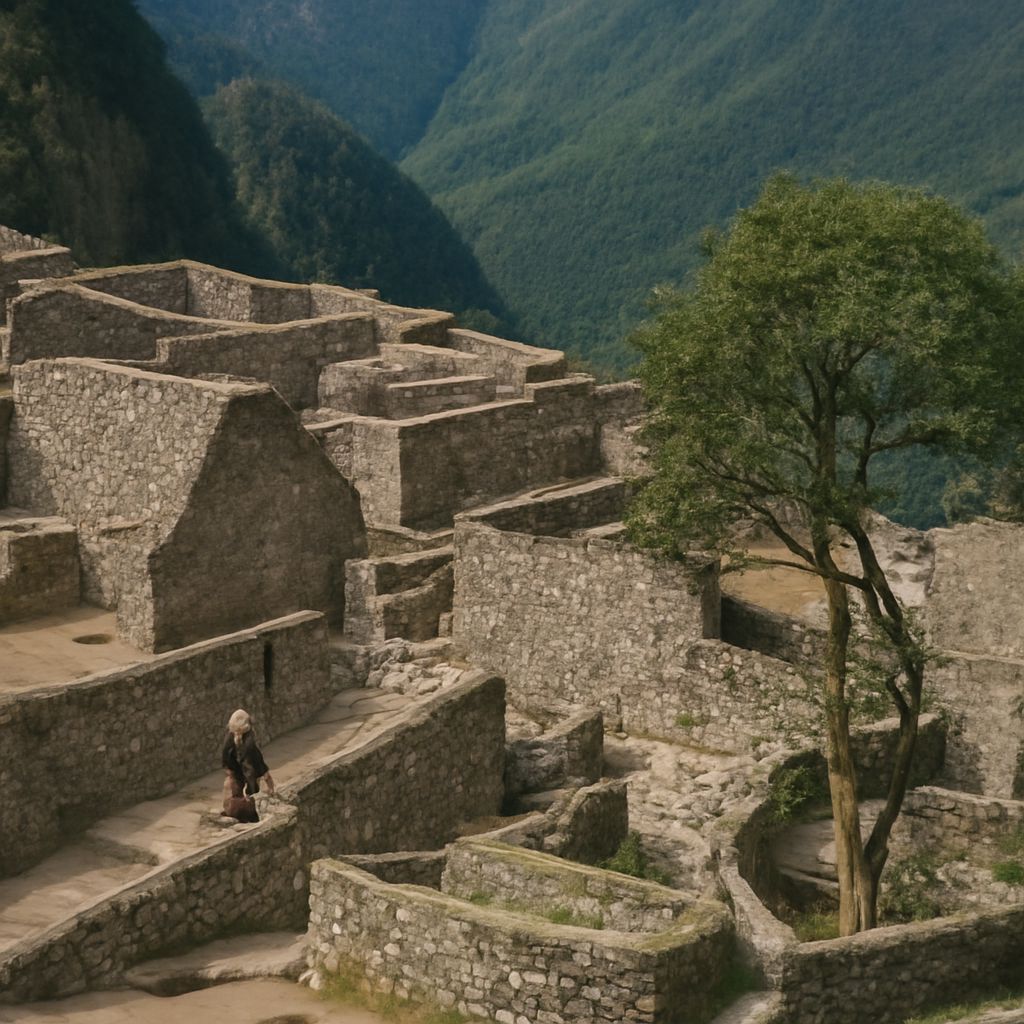
Inca rulers and their subjects are sometimes imagined as a single people who created Andean society from nothing. In fact, their state grew from a kingdom centered on Cusco and incorporated many distinct communities with long histories of their own. The empire of the Incas drew on earlier Andean knowledge even as its rulers imposed new political relationships.
“Inca” can refer to a ruler or ruling group as well as, more broadly, to the people and institutions associated with the state. Inka, a Quechua spelling used by the Smithsonian’s National Museum of the American Indian, emphasizes the Indigenous language behind the familiar English form. The distinction matters: the subjects of Inca rule did not all share a single identity or experience of imperial power.
The Inca and Their Andean Predecessors
The Inca empire rose within a region shaped by thousands of years of agriculture, exchange, religious practice, and political experimentation. Earlier societies such as Tiwanaku and Wari had developed institutions and infrastructure across parts of the Andes. Their histories were distinct, but their achievements formed part of the wider setting in which a later Cusco-based kingdom expanded.
According to the National Museum of the American Indian’s timeline, this kingdom emerged centuries before its rapid imperial growth. In the fifteenth century, rulers including Pachacuti and his successors expanded their reach through warfare, diplomacy, and alliances. Local leaders might negotiate incorporation, while other communities resisted and faced force. Expansion was a process with different outcomes in different places, not a single event.
By the early sixteenth century, near its greatest extent, the Andean empire encompassed territory in parts of what are now Peru, Ecuador, Bolivia, Chile, Argentina, and Colombia. Those modern names are geographic reference points, not descriptions of countries that existed at the time. Mountains, coast, high plateaus, and valleys connected communities with varied economies and languages.
A Ruler, a Realm, and Many Communities
The supreme ruler, often called the Sapa Inca, stood at the center of a hierarchy that linked the royal household to provincial administrators and local authorities. Cusco was the political and ceremonial center. The state called its realm Tawantinsuyu, commonly translated as the four regions, reflecting a way of organizing territory around that center.
Government depended on relationships with local leaders as well as officials sent from the capital. These intermediaries could help organize labor and communicate demands, but their communities were not simply interchangeable parts of a uniform society. Imperial rule might bring access to stored food or political protection while also requiring labor, resettlement, and allegiance. Whether a community regarded the relationship as an opportunity, an imposition, or both depended on its circumstances.
The Inca civilization is sometimes described chiefly through monumental stonework, yet governance also rested on farming communities, herders, craftworkers, and their knowledge of local environments. People adapted to conditions ranging from dry coastal valleys to high mountain pastures. The state’s capacity to draw on those resources was inseparable from the work and expertise of its subjects.
Roads, Labor, and Records
A network of roads linked administrative centers, storehouses, and communities across difficult terrain. The state improved and connected routes that included older roads, using them to move officials, messages, goods, and forces. Along the network, facilities supported travel and stored supplies. Roads joined places politically as well as physically: their benefits and burdens varied with the needs of the state and the people who maintained them.
Labor obligations were central to administration. Communities supplied workers for state projects and other duties in rotation, a system often called mit’a. State authorities could redistribute resources held in storehouses, including food and textiles. Reciprocity was an important Andean principle, but obligations under an expanding empire also involved coercive authority; the two ideas should be considered together.
Officials recorded information with khipus, devices made from knotted cords. The Smithsonian’s account of road administration describes their use for census data and the movement of goods and people. Such records helped a government without alphabetic writing manage resources across a large and varied territory. They were part of a broader system of knowledge, not merely a substitute for a European form of writing.
Succession and Spanish Conquest
The incan empire did not follow a simple rule in which the eldest son automatically inherited power. Members of the royal family and their supporters played roles in succession, and rival claims could produce conflict. After the death of ruler Huayna Capac, a struggle between his sons Huascar and Atahualpa weakened the state. Epidemic disease, introduced from the Old World, had also caused devastating losses before Spanish forces arrived in the imperial heartland.
In 1532 Francisco Pizarro and his men captured Atahualpa at Cajamarca. Spanish forces exploited existing divisions and worked with Indigenous allies whose interests differed from those of Cusco’s rulers. The capture was a decisive blow, but the conquest unfolded over years rather than ending in a single encounter. An Inca-led resistance continued from Vilcabamba until its final stronghold fell in 1572.
Andean Communities After Imperial Rule
Spanish colonial rule transformed landholding, labor, religion, and political authority across the Andes. Its institutions placed heavy demands on Indigenous communities, which nevertheless adapted, negotiated, and maintained traditions under changing conditions. The end of an imperial state was not the disappearance of the peoples who had lived within it.
Quechua and Aymara languages remain living languages, and communities continue to sustain knowledge of agriculture, weaving, and relationships with the land. The museum’s account of resistance and adaptation shows how Andean makers combined inherited skills with new materials after conquest. Contemporary communities are active interpreters and caretakers of that history, with perspectives that cannot be reduced to the viewpoint of either imperial court.